
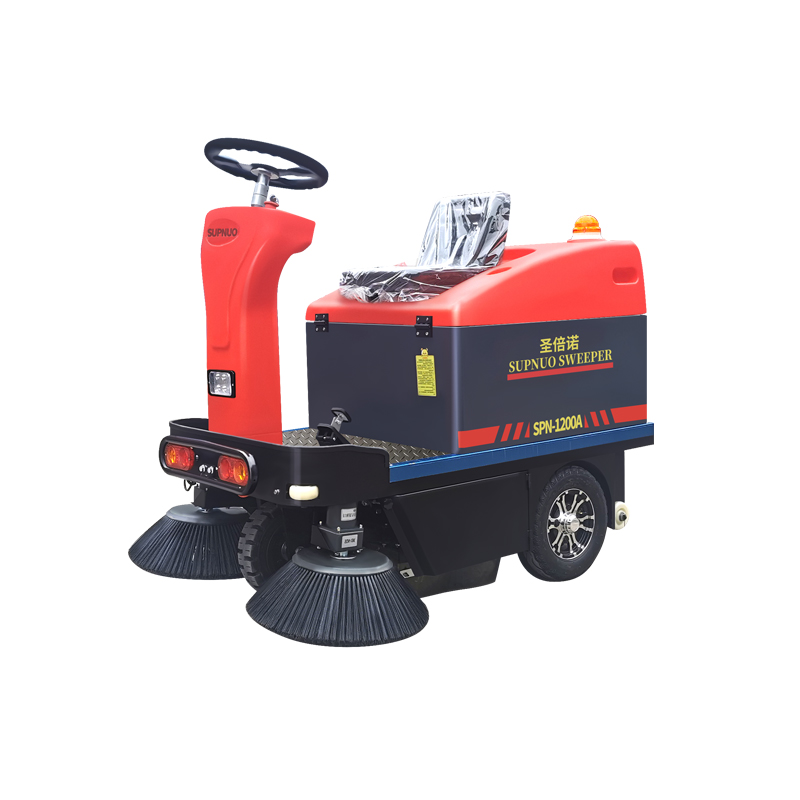
Start with a needs assessment (before you compare spec sheets)
A battery powered sweeper only works as well as the assumptions you buy it with. Before you look at sweeping widths or “m²/h,” lock down these inputs:
Area to clean per shift: total square footage and how much must be swept (vs. “nice to have”).
Cleaning window: the real time you have (off-shift, staggered breaks, between production runs).
Layout constraints: narrowest aisle, tightest turning area, ramps, dock plates, door clearances.
Debris profile: mostly fine dust, mixed debris, or heavier material (chips, pellets, packaging scraps).
EHS / compliance context: do you have airborne dust exposure concerns (e.g., silica) or indoor air quality requirements?
Support constraints: how fast do you need parts/service, and do you need remote support for multi-site teams?
Pro Tip: If you can’t clearly describe your dust and debris, your team will default to buying “bigger.” In manufacturing, “bigger” often means “can’t fit where the mess is.”
Walk-behind vs. ride-on: a practical way to decide
Most procurement mistakes happen here: teams buy a ride-on for productivity… then discover it can’t navigate the routes that actually matter.
Use a simple rule: buy for the most constrained route, not the most open area.
Walk-behind sweepers tend to win in obstacle-heavy routes and narrow aisles.
Ride-on sweepers tend to win in large open areas where coverage rate is everything.
If you want an external benchmark for this split, Tennant’s guidance on choosing commercial floor sweepers frames the same tradeoff: smaller units fit tighter spaces, while ride-ons cover more ground faster—especially in large warehouses and manufacturing facilities.
The evaluation criteria that actually drive uptime and TCO
1) Productivity you can use (not just marketing “m²/h”)
Ask vendors for productivity numbers and the assumptions:
What forward speed was assumed?
What debris load?
How often was the hopper/bin emptied?
Was the route constrained or wide open?
For wide-area models, manufacturer sites often list productivity-style claims like “over 15,000 m²/h” and describe “sweeping + suction + spraying” as the working method. Treat this as a starting point—then validate it against your own route and debris reality.
2) Dust control: capture vs. re-suspension
In manufacturing, dust control isn’t cosmetic. It’s:
air quality,
slip risk,
contamination risk,
and (sometimes) compliance exposure.
What to verify during a demo:
How dust is controlled at the side brooms (common dust-throw point).
Whether the broom chamber is sealed and supported by vacuum airflow.
How the machine behaves during dumping (dust can escape when you empty the hopper).
The SUNBON SBN-25000AW page claims an integrated “sweeping, suction, and spraying” approach and “dust collection efficiency up to 95%.” Use that claim as a demo checklist item: “Show me how this stays controlled while sweeping and while dumping.”
3) Filtration: when HEPA matters (and when it doesn’t)
Some teams treat HEPA as a default requirement. Others ignore it completely. The right answer depends on your dust hazard.
Nilfisk’s compliance explainer, Does your industrial sweeper need a HEPA filter under OSHA’s silica dust rule?, makes a key point: HEPA is not universally required for industrial sweepers under the silica rule, as long as you comply with other exposure-control requirements and maintain equipment per manufacturer guidance.
That doesn’t mean HEPA never matters. It means you should make filtration a risk-based decision:
If you have fine particulate exposure concerns, ask for HEPA-grade options and maintenance procedures.
If you’re dealing mostly with larger debris and nuisance dust, robust sealing + good fine filters may be the better value.
4) Battery choice: lithium vs lead-acid (match it to your cleaning window)
This is the heart of the lithium vs lead-acid floor sweeper battery decision.
Lead-acid batteries can make sense when:
you run one shift,
you have reliable overnight charging windows,
and your team consistently follows battery discipline.
Lithium batteries make sense when:
you have short cleaning windows,
you run multi-shift,
you want opportunity charging (top-ups during breaks),
or you’re trying to reduce daily maintenance tasks.
A dealer perspective that’s actually useful in operations is Wisconsin Scrub & Sweep’s lithium-ion vs lead-acid comparison. Their practical points are the ones procurement teams care about:
lead-acid typically needs long full charge windows (they cite “8+ hours”),
interrupted charging can shorten lead-acid life,
lithium supports short-burst charging without the same penalties.
⚠️ Warning: Don’t treat lithium as “set-and-forget.” Your EHS and maintenance teams still need clear charging procedures, inspection routines, and documentation—especially if you standardize across sites.
5) Serviceability and parts support (the hidden cost center)
In multi-site manufacturing, the “best sweeper” is the one you can keep running.
Evaluate:
filter access and cleaning steps,
brush replacement time,
how consumables are sourced,
how warranty claims are handled,
and whether remote support can meaningfully reduce downtime.
Many manufacturers state one-year warranty terms and remote technical support on product pages. Validate it during procurement: “What’s the typical part lead time to our region? What are the consumables? What’s excluded as wear?”
Keywords to keep on-page (use naturally)
Primary: battery powered sweeper
Secondary: industrial battery powered sweeper; battery powered floor sweeper for warehouse; walk-behind vs ride-on sweeper; lithium vs lead-acid floor sweeper battery
A battery powered sweeper TCO model (use this to compare bids)
Don’t compare sweepers on purchase price. Compare them on cost per cleaned square foot or cost per operating hour.
Include these line items:
Labor time: hours per sweep * fully loaded labor cost.
Consumables: brushes, filters, skirts, etc.
Battery lifecycle: expected replacements and cost (and charger compatibility).
Downtime cost: if a sweeper is down, what does it do to production flow, safety risk, or overtime?
Preventive maintenance time: daily/weekly PM plus periodic deep service.
Training: new operator onboarding time (turnover is real).
If you’re standardizing across sites, add one more: fleet commonality. A slightly higher unit price can be justified if it reduces the number of unique consumables and training variations you manage globally.
Example equipment paths (neutral examples, not recommendations)
If you want internal examples to sanity-check your decision framework:
Walk-behind sweeper option for mixed areas: SUNBON SBN-1050 (page emphasizes low noise / minimal dust emission and mixed environments).
Ride-on, large-area path: SUNBON SBN-2000AB (site lists 2000 mm cleaning width and >15,000 m²/h cleaning efficiency).
Wide-area industrial path: SUNBON SBN-25000AW (note: the page lists both 2000 mm and 2500 mm sweeping widths—verify on a formal spec sheet before locking requirements).
Combined sweeper-scrubber concept: SUNBON SBN-XS90 (site describes a two-stage dust control system).
Robotic/automation path: SUNBON SBN-WR1400 (site lists 1400 mm cleaning width and lidar/ultrasonic obstacle avoidance).
FAQ
Is a battery powered sweeper better than gas for indoor manufacturing?
Often, yes—battery units avoid local exhaust and can be quieter, which is why many facilities prefer them indoors. The bigger decision is whether you can support the charging workflow and maintenance discipline.
Do we need HEPA filtration on a sweeper?
Not automatically. Make it a risk-based decision tied to your dust hazard. Nilfisk’s OSHA silica overview explains that HEPA isn’t universally mandated for sweepers under the silica rule, provided other controls and maintenance requirements are met.
Lithium vs lead-acid: what’s the most common mistake?
Buying lead-acid for a facility that doesn’t have a reliable overnight charging window—or buying lithium and skipping the process work (training, charging SOPs, EHS review) needed to standardize safely.
Next steps
If you want, share three numbers and you can get to a short list fast:
the square footage you need to sweep per shift,
your cleaning window (minutes/hours),
your debris profile (fine dust vs mixed vs heavy).
From there, SUNBON can help you map a battery powered sweeper configuration to your constraints (including walk-behind vs ride-on and battery type) and confirm what filtration and dust-control setup is appropriate for your environment.





