
If you’re running a factory or warehouse, “smart” cleaning equipment is only smart if it fits your floor, your cleaning windows, and your service reality.
In this guide, you’ll get a practical way to evaluate options (robotic, ride-on, walk-behind), a shortlist checklist, and the red flags that keep promising demos from turning into uptime problems.
Decision factor | What to decide | Why it matters in manufacturing/warehousing |
|---|---|---|
Zone fit | Which areas need sweeping vs scrubbing, and which are realistic for autonomy | The right machine for the wrong zone becomes downtime |
Autonomy maturity | Navigation, obstacle handling, docking/refill workflow, reporting | “Runs itself” only works with stable conditions |
Safety + governance | Risk assessment, SOPs, operator access controls | Robots operate around people and equipment |
Uptime logistics | Battery, charging strategy, water handling, shift timing | Cleaning windows are tight; interruptions are expensive |
Serviceability | Parts, warranty terms, response process, training | Service delays drive hidden TCO |
ROI/TCO | Labor hours, consumables, floor preservation, injury risk | Procurement needs defendable payback logic |
What counts as “smart cleaning equipment” in industrial sites
In factory and warehouse contexts, “smart cleaning equipment” usually means one (or both) of the following:
Automation: robotic scrubbers/sweepers that can map, avoid obstacles, and run scheduled routes.
Operational visibility: connected reporting and controls—so supervisors can verify coverage, track issues, and keep the program consistent across shifts/sites.
That’s useful because manufacturing sites don’t fail on “cleaning intent.” They fail on repeatability: tight cleaning windows, changing traffic patterns, labor turnover, and maintenance constraints.
Step 1: Do a quick needs assessment before you compare models
Start by splitting your site into zones. You’re trying to match equipment to physics.
Production floor (fine dust, metal shavings, grit): dust control and debris pickup are often the priority before or alongside scrubbing.
Warehouse aisles + racking: maneuverability and edge performance matter more than theoretical coverage.
Shipping/receiving + docks: high debris load, lots of obstacles, and layout changes (pallets move all day).
Corridors + common areas: usually predictable—often a better fit for autonomy.
This 10-minute exercise stops you from buying “general” equipment when you actually need factory floor cleaning equipment tuned to your constraints.
Pro Tip: When estimating capacity, assume real-world output is lower than the spec sheet. Kärcher’s warehouse guidance notes that practical performance is typically reduced versus theoretical capacity due to interruptions and non-straight travel (see Kärcher’s warehouse cleaning criteria).
Step 2: Choose the equipment class that actually fits your zones
This is where most programs go wrong: buying a machine for “the whole facility” that isn’t right for any of the hard parts.
Autonomous/robotic (when “smart” is worth paying for)
An autonomous floor scrubber or robotic floor scrubber tends to perform best when:
routes are repeatable (same zones, same constraints)
there’s a clear cleaning window (often off-shift)
you can enforce an operating area (less forklift chaos)
They tend to struggle when:
pallets and staging areas move constantly
tight aisles require frequent human intervention
no one owns SOPs, route updates, and recovery tasks
Ride-on (coverage and consistency for large open areas)
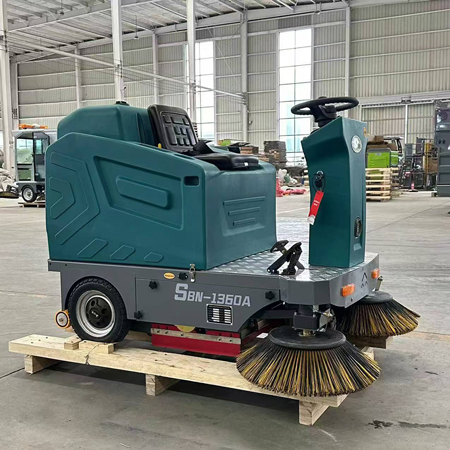
Ride-on equipment is often the workhorse for bigger, open spaces where speed and tank capacity matter. For many sites, that means pairing an industrial floor sweeper with a scrubber program based on the debris load.
Kärcher’s warehouse selection guidance frames the classic split: walk-behind for smaller spaces, ride-on for larger warehouses, with the right brush technology depending on dirt and floor type.
Walk-behind (control, edges, and tighter layouts)
Walk-behind machines are typically easier to fit into narrow areas and can be a safer bet when the layout is complex.
A practical reminder from an equipment buyer’s guide: avoid assuming bigger is better—edge access, maneuverability, and tank handling can matter as much as width (see i-team’s guide to choosing the right floor scrubber).
Step 3: Evaluate “smart” features like a reliability engineer
Don’t start by asking “Does it have AI?” Start with: What are the failure modes?
Navigation and obstacle behavior
Ask vendors:
What sensors and mapping approach are used (e.g., LiDAR + ultrasonic)?
What happens when a route is blocked—reroute, pause, alert, or fail?
How does it behave around forklifts and pedestrian crossings?
Autonomy workflow: charging, water, and recovery
Autonomy isn’t only navigation. It’s whether your team can keep it running with minimal overhead:
How is charging handled (dock, swap, manual)?
How is clean water refilled and recovery emptied?
What’s the expected “human touch time” per shift?
Verification and reporting
In a multi-site program, reporting matters because it reduces arguments and guesswork:
route completion proof (coverage maps, run logs)
exception reports (stops, errors, missed zones)
maintenance alerts tied to uptime
Step 4: Treat safety and governance as a buying criterion
Robotic cleaning adds a moving machine into shared space. That’s a governance problem, not just a product feature.
Tennant’s guidance highlights the practical implementation steps: do a risk assessment, document findings in an SOP, train staff, and choose machines with controls like emergency stops and access restrictions (see Tennant’s safety considerations for robotic cleaning machines).
⚠️ Warning: If no one owns the SOP (routes, obstacle rules, charging areas, emergency stop procedures, daily checks), autonomy tends to collapse into “manual babysitting”—and the ROI case disappears.
Step 5: Use a shortlist checklist (pass/fail) before demos
Use this checklist to narrow to 2–3 finalists.
Facility-fit (must pass)
Fits your narrowest aisles and turning points in the target zones
Handles your dominant debris type (fine dust vs larger debris)
Works on your floor texture and coating requirements
Uptime-fit (must pass)
Can complete the route inside your cleaning window
Charging strategy matches your shifts (dock/swap/manual)
Water handling is realistic for your site (location, plumbing, drains)
Service-fit (must pass)
Clear warranty terms and exclusions (consumables vs defects)
Defined parts availability approach
Training plan for operators and maintenance techs
Safety-fit (must pass)
Emergency stop access
Access control (trained operators only)
Site risk assessment support and SOP documentation
If a vendor can’t answer these without hand-waving, don’t schedule the demo.
Step 6: Build a defendable ROI/TCO story (without fantasy math)
Your ROI case should be based on inputs you can verify:
Labor hours today: how many hours/week are spent on sweeping/scrubbing in the target zones?
Cleaning frequency and shift constraints: daily vs weekly; off-shift vs live traffic.
Downtime cost: what happens when a machine is down (missed cleaning, slip risk, rework)?
Consumables and maintenance: brushes, squeegees, filters, detergents.
Floor protection: abrasion and debris can shorten floor coating life (site-specific but real).
For a structured way to justify equipment spend to leadership, Nilfisk provides a practical budget-justification framework you can adapt (see Nilfisk’s warehouse cleaning equipment budget justification tool (2019)).
Example: How to include SUNBON in your shortlist (without turning this into a brochure)
If you’re evaluating vendors, it helps to keep product examples tied to criteria:
Portfolio context: SUNBON’s site includes industrial scrubbers, sweepers, and robotic equipment, with CE/ISO9001 certification and stated QC and service policies.
Robotic sweeping example (automation + obstacle avoidance): the SBN-WR1400 autonomous robotic sweeper describes multi-line lidar and ultrasonic radar for obstacle avoidance.
Intelligent scrubbing example (autonomy workflow): the SBN-S90 intelligent floor scrubber highlights a workstation-based auto charging and water refilling workflow.
When comparing, keep the questions consistent across vendors:
What’s the warranty term and what’s excluded?
What’s the plan for parts and response time?
What training and SOP support is included?
Next steps
If you want, share three quick details and you can get a tighter shortlist:
Facility type (manufacturing, distribution, mixed)
Primary target zones (production, aisles, docks, corridors)
Cleaning window (hours available) and staffing reality
Mid-step consultative CTA: Talk to SUNBON about a site-fit recommendation and spec check based on your zones and cleaning windows.
Decision CTA: If you’re ready to shortlist, start with the SUNBON industrial cleaning equipment portfolio and request a recommendation for your facility layout and debris profile.





