
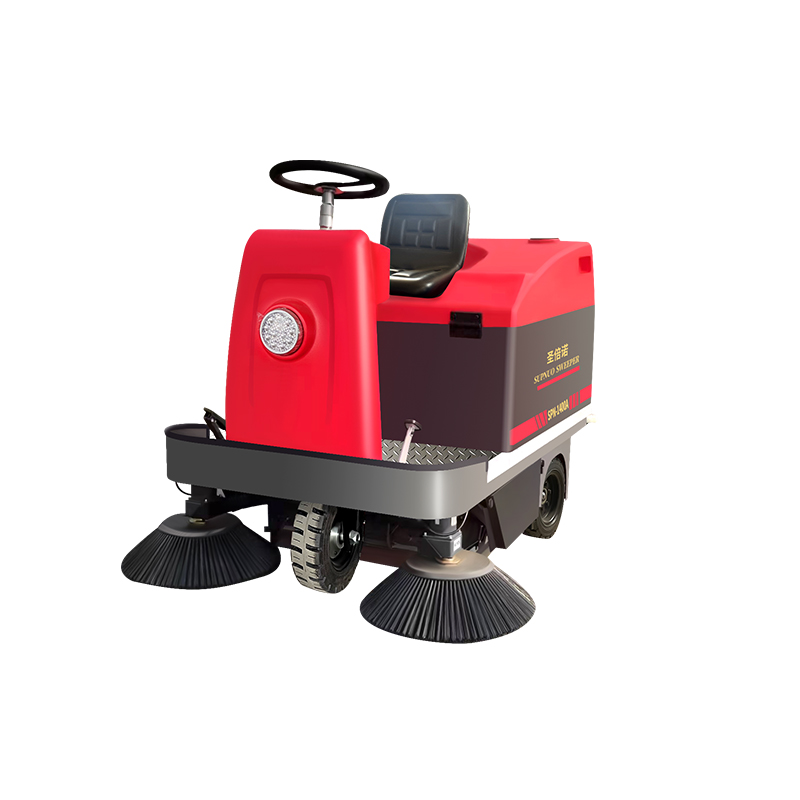
Maintaining clean floors across large industrial facilities, manufacturing plants, and distribution centers is a persistent operational challenge. Manual push-sweeping or small walk-behind units require significant labor hours, struggle to contain fine airborne concrete dust, and slow down routine facility operations.
For facilities over 30,000 square feet, upgrading to a commercial ride on sweeper converts floor care into a fast, single-operator task. Riding sweepers combine wide sweeping paths, high-capacity waste hoppers, and heavy-duty vacuum filtration to clear dust, packaging scrap, metal shavings, and pallet splinters in a fraction of the time.
This guide breaks down essential technical specifications, compares battery power options, provides a facility sizing matrix, and details the total cost of ownership (TCO) math to help operations leaders select the right floor sweeper.
Why Upgrade to a Commercial Ride On Sweeper?
The primary driver for adopting a riding floor sweeper is operational productivity. Manual broom sweeping covers approximately 2,500 to 4,000 square feet per hour while dispersing fine particulate matter into the air.
By contrast, an industrial ride on sweeper cleans between 75,000 and 215,000 square feet per hour, depending on working width and driving speed. According to the ISSA 612 Cleaning Times & Tasks guide, transitioning from manual floor sweeping to a riding sweeper cuts labor hours by up to 85% to 90% in commercial and industrial settings.
Cleaning Method | Typical Sweeping Path | Average Cleaning Speed | Estimated Coverage Rate |
|---|---|---|---|
Manual Broom Sweeping | 24 in (600 mm) | 1.0–1.5 mph | 2,500–4,000 sq ft/hr |
Walk-Behind Floor Sweeper | 28–36 in (700–900 mm) | 2.0–2.5 mph | 15,000–35,000 sq ft/hr |
Compact Ride On Sweeper | 48–55 in (1,200–1,400 mm) | 3.5–4.0 mph | 75,000–100,000 sq ft/hr |
Heavy-Duty Industrial Rider | 65–78 in (1,650–2,000+ mm) | 4.0–6.0 mph | 150,000–215,000+ sq ft/hr |
Beyond speed, riding sweepers deliver critical health and safety benefits:
Airborne Dust Containment: Integrated vacuum fans pull fine dust into high-surface filter panels rather than recirculating silica dust into worker breathing zones or onto inventory.
Slip and Trip Hazard Reduction: Sweepers clear stray hardware, wood chips, and granular material that cause slips or puncture forklift tires.
Operator Ergonomics: Seated operation reduces worker fatigue and janitorial turnover compared to pushing heavy equipment across long warehouse aisles.
Key Technical Specifications to Evaluate
Selecting a commercial sweeper requires matching machine capabilities with floor layout, debris types, and cleaning schedules.
Sweeping Path & Brush Configuration
A sweeper’s cleaning path is determined by its central cylindrical broom and its side disc brushes:
Central Main Broom: Drives heavy debris (pallet debris, metal scrap, rocks) directly into the waste hopper.
Side Brushes: Extend beyond the machine frame to pull dust and litter away from walls, rack bases, and curbing into the path of the main broom.
Compact models utilize a 48-inch (1,200 mm) path with one side brush, while large industrial units feature dual side brushes providing a 78-inch (2,000 mm) cleaning width for wide-open plant floors.
Dust Filtration & Filter Area
Vacuum sweeping systems rely on internal filter panels to capture fine particles:
Filter Area: Compact units typically feature 2.7 to 4.0 m² of filter media, while heavy-duty industrial units offer 8.0 to 12.0+ m² to prevent suction loss in dusty concrete environments.
Electric Filter Shakers: Automated shaker motors vibrate the filter panel during operation or upon hopper dumping, dislodging caked dust without requiring manual filter removal.
Hopper Capacity & Dumping Systems
Hopper volume dictates how long an operator can sweep before interrupting work to empty collected waste:
Capacity Range: Hoppers range from 70 liters (2.5 cu ft) on compact riders to over 250 liters (8.8 cu ft) on heavy industrial machines.
High-Hydraulic Dump: Large riders feature hydraulic lifting arms that raise the hopper up to 59 inches (1,500 mm), allowing the operator to dump waste directly into standard industrial dumpsters without manual lifting.
Drive System & Gradeability
Industrial facilities often feature ramped loading docks, parking decks, or inclined transitions between building sections. Verify that the sweeper offers a gradeability rating of 16% to 25% to ensure reliable climbing performance under full hopper load.
Battery Power: Lithium-Ion vs. AGM Lead-Acid Sweepers
Power source selection directly impacts machine uptime, maintenance routines, and long-term operating costs. While LPG and diesel sweepers remain common for outdoor yards, battery-electric models dominate indoor warehouse environments due to zero exhaust emissions and low noise levels.
Item | Detail |
|---|---|
Lithium-Ion | Fast Charge (2-3 hrs) → Opportunity Charging → 3,000+ Cycles → Zero Maintenance |
AGM Lead-Acid | Slow Charge (8-10 hrs) → Full Cooldown Needed → 500-800 Cycles → Sensitive to Deep Discharge |
Feature / Metric | Lithium-Ion Battery System | AGM Lead-Acid Battery System |
|---|---|---|
Operational Runtime | 4 to 8 hours per charge | 3 to 5 hours per charge |
Recharge Time | 2 to 3 hours | 8 to 10 hours |
Opportunity Charging | Fully supported (during breaks/lunch) | Not recommended (causes thermal degradation) |
Lifespan Expectancy | 3,000 to 5,000+ cycles (7–10 years) | 500 to 800 cycles (2–3 years) |
Maintenance Requirements | Zero watering or equalization | Periodic terminal cleaning & strict charging discipline |
Discharge Efficiency | Constant voltage output until empty | Voltage drops as charge depletes, reducing motor power |
Pro Tip: For multi-shift logistics hubs operating 16 to 24 hours daily, lithium-powered sweepers eliminate battery-swapping infrastructure. Short 30-minute top-up charges during shift changes keep the sweeper ready without requiring extra battery packs.
Sizing Guide: Matching Machine Specs to Facility Square Footage
Over-specifying a sweeper leads to unnecessary capital expenditure, while under-specifying leads to excessive charging downtime and accelerated wear.
Facility Floor Area → Choose Sweeping Width → Verify Hopper & Filter Specs → Select Battery Type
Facility Size Under 30,000 Sq Ft
Recommended Category: Compact Electric Ride On Sweeper
Sweeping Path: 48 to 55 inches (1,200 to 1,400 mm)
Hopper Capacity: 70 to 100 Liters
Best Suited For: Narrow warehouse aisles, automotive service centers, light manufacturing shops, and commercial garages.
Facility Size 30,000 to 100,000 Sq Ft
Recommended Category: Mid-Sized Industrial Riding Sweeper
Sweeping Path: 55 to 67 inches (1,400 to 1,700 mm)
Hopper Capacity: 120 to 180 Liters
Best Suited For: Medium logistics distribution centers, food & beverage staging areas, and commercial assembly plants. Follow established commercial floor sweeper selection guidelines when balancing turning radius with sweeping width.
Facility Size Over 100,000 Sq Ft
Recommended Category: Heavy-Duty Industrial Rider
Sweeping Path: 70 to 78+ inches (1,800 to 2,000+ mm)
Hopper Capacity: 200 to 250+ Liters (with Hydraulic High-Dump)
Best Suited For: Large manufacturing complexes, multi-dock warehouse hubs, steel mills, and outdoor paved industrial yards. Refer to our industrial floor sweeper buyer guide for heavy debris guidelines.
Ride-On Floor Sweepers vs. Floor Scrubbers: What’s the Difference?
A common procurement question is whether to invest in a floor sweeper, a floor scrubber, or a sweeper-scrubber combination machine.
Ride On Floor Sweeper: Built for dry debris collection and dust control. Uses rotating brooms and high-volume vacuum airflow to sweep dirt, sand, sawdust, pallets splinters, and trash into a hopper.
Ride On Floor Scrubber: Built for wet cleaning and soil removal. Applies water and detergent, agitates the surface with scrub brushes to remove oil, grease, and tire marks, and vacuums dirty water into a recovery tank.
Warning: Never run a standard floor scrubber over loose dry debris, nails, or heavy metal shavings. Debris clogs scrubber squeegees and damages vacuum fan impellers. Always sweep dry debris prior to wet scrubbing, or consider paired equipment for heavy industrial sites. If wet cleaning is required, evaluate specialized ride-on floor scrubbers designed for scrub-and-dry applications.
Total Cost of Ownership (TCO) & ROI Calculation
Evaluating a riding sweeper on initial purchase price alone overlooks the substantial labor savings that drive return on investment.
Sample ROI Calculation Scenario
Consider a 60,000 sq ft logistics facility requiring daily floor sweeping:
Manual Sweeping:2 custodians sweeping for 4 hours daily = 8 labor hours/day. At an average loaded wage of $25/hour, daily sweeping costs$200/day ($60,000 annually).
Ride On Sweeper: 1 operator completes the full 60,000 sq ft area in 45 minutes = 0.75 labor hours/day ($18.75/day or $5,625 annually).
Annual Labor Savings: $54,375 saved per year.
With a commercial riding sweeper purchase price typically ranging between $9,000 and $18,000, most industrial facilities achieve full equipment payback within 3 to 6 months of deployment.
Published industry benchmarks, including Kärcher industrial floor sweeper technical benchmarks, demonstrate similar labor hour compressions across high-square-footage facilities.
Sunbon Ride-On Sweeper Solutions: Factory-Direct Engineering
When selecting an equipment partner, manufacturing quality and after-sales support are paramount. Sunbon brings over 13 years of manufacturing expertise, operating four specialized production facilities spanning 30,000 square meters with over 300,000 cleaning machines deployed globally.
Engineering Advantages of Sunbon Sweepers
Modular Component Design: Electrical controllers, drive motors, and broom assemblies are built on modular sub-assemblies, allowing rapid on-site maintenance without complex teardowns.
High-Performance Lithium Technology: Integrated maintenance-free lithium battery packs deliver consistent power output, zero-maintenance upkeep, and 3,000+ cycle operational life.
Certified Quality Standards: Every unit holds CE and ISO9001 certifications and undergoes 100% factory performance and quality inspection prior to shipment.
Heavy-Duty Sweeping Widths: Flagship models such as the SBN-2500AW industrial ride-on sweeper feature a 2,000 mm sweeping path, cleaning over 215,000 sq ft/hr for large industrial plants, municipal facilities, and logistics yards.
Frequently Asked Questions (FAQ)
Can a ride-on sweeper clean outdoor parking lots and loading docks?
Yes. Industrial riding sweepers are designed to transition between indoor polished concrete and outdoor asphalt, concrete aprons, and loading docks. For outdoor use with stones and leaves, select a machine with a heavy-duty main broom and high ground clearance.
How often should the sweeper dust filter be cleaned?
Automated electric filter shakers should be activated after every hopper discharge or every 1 to 2 operating hours in dusty environments. Main filter panels should be inspected monthly and gently blown out with compressed air to preserve suction performance.
How long do lithium sweeper batteries last on a single charge?
High-capacity lithium battery packs provide 4 to 8 hours of continuous sweeping, depending on motor load and brush pressure. With short opportunity charges during lunch or shift breaks, lithium sweepers run continuously across multi-shift schedules.
Optimize Your Facility Cleaning Efficiency
Upgrading your floor maintenance routine with a high-efficiency riding sweeper lowers operational costs, improves workplace safety, and protects facility assets. Contact our engineering team at Sunbon to request a customized facility sweeping audit, review detailed equipment specifications, or receive direct-factory pricing.





