
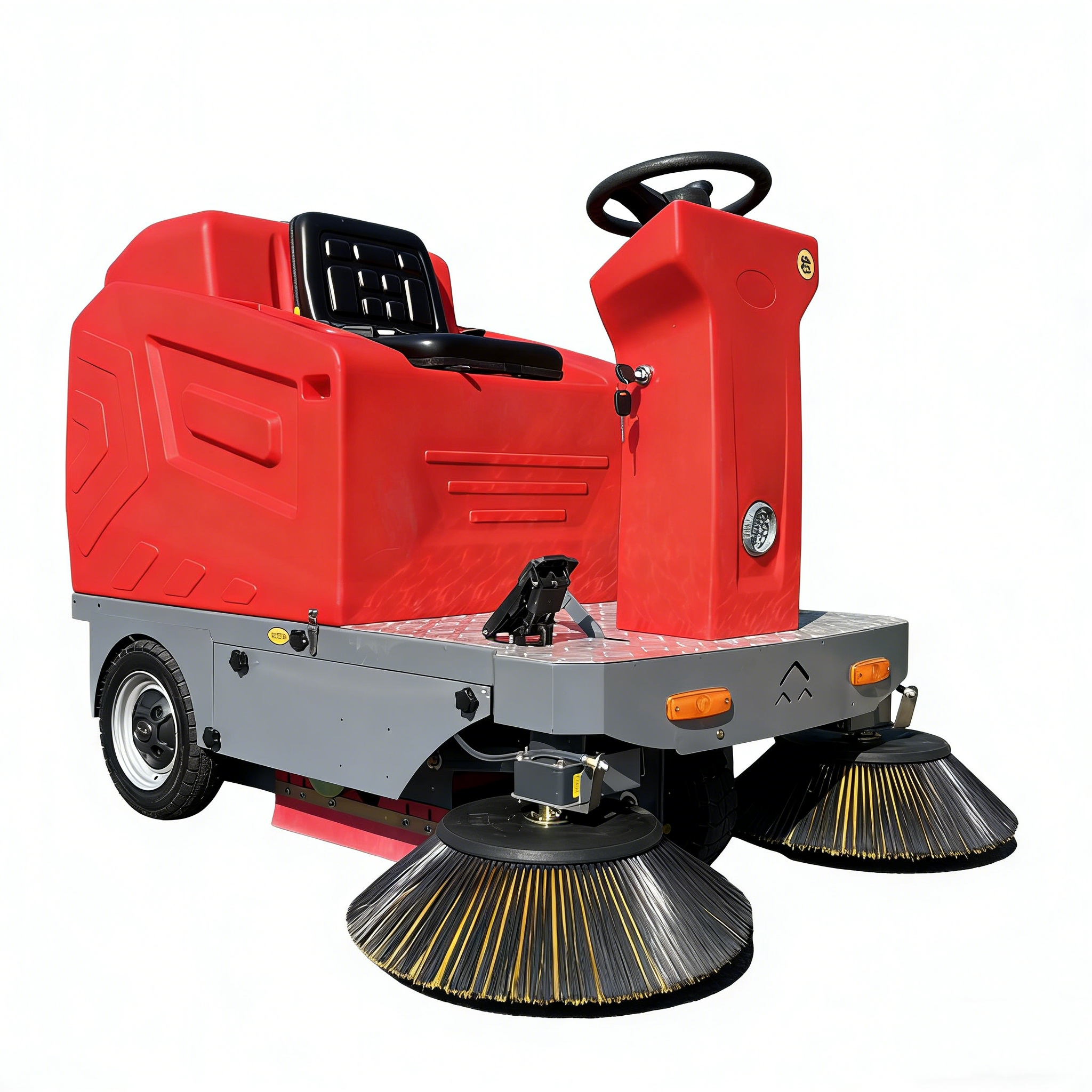
If you’re buying an industrial warehouse sweeper, you’re usually trying to solve two problems at once:
Keep dust and debris from turning into safety incidents, product contamination, or equipment wear.
Do it inside tight cleaning windows, with high operator turnover, without creating a maintenance headache.
This guide is built for that reality. It gives you a comparison framework you can use across multiple sites, plus a checklist you can bring into demos and quote reviews.
Decision | Walk-behind warehouse sweeper | Ride-on warehouse sweeper | Autonomous/robotic sweeper |
|---|---|---|---|
Best fit | Tight aisles, racks, frequent turns, spot-heavy routes | Large open bays, long straight runs, big daily coverage | Repetitive routes, labor constraints, consistent schedules |
Productivity potential | Moderate (operator pace + turning) | High (coverage + less fatigue) | High when the route is stable and the environment is predictable |
Dust control potential | Good if filtration and sealing are strong | Good to excellent depending on vacuum/filtration design | Depends on platform; validate obstacle handling and dust containment |
Upfront cost | Lowest | Higher | Highest |
Operational risk | Lower speed, but operator fatigue and consistency vary | Requires turning space and safe traffic rules | Requires change management, mapping, and a clear escalation process |
What to verify in demos | Dust capture, filter cleaning, maneuverability, dump workflow | Route fit, dumping workflow, suction consistency under load | Navigation safety, edge coverage, “what happens when…” scenarios |
Pro Tip: Before you compare brands, compare your routes. A “perfect” machine that can’t make the turns, fit the dump point, or finish inside your cleaning window won’t survive procurement.
Step 1: Do a quick needs assessment (10 minutes that saves you weeks)
Write down these numbers before you talk to vendors:
Total floor area you expect to sweep per shift (don’t count areas you never touch).
Route constraints: narrowest aisle, tightest turn, lowest clearance, and any ramps.
Debris profile (be specific): fine concrete dust, pallet wood chips, shrink wrap, metal shavings, sand/grit from dock doors.
Dust risk level: Does dust create quality issues (packaging, electronics, food areas) or primarily safety/housekeeping issues?
Cleaning window: how many minutes you really have (including dumping and battery swaps/charging).
Support reality: do you have in-house maintenance, or do you rely on vendor service? How fast do you need parts?
If you can’t answer these, you’re likely to overbuy (capex waste) or underbuy (labor and downtime waste).
Step 2: Confirm you need a sweeper, not a scrubber
A sweeper is built to pick up dry debris and dust. A scrubber is built to remove stuck-on soil, grease, and films with water and detergent.
Many facilities need both on different schedules. If you’re unsure, TVH’s overview on industrial floor scrubbers vs sweepers is a solid quick reset.
Industrial warehouse sweeper selection: the 8 criteria that decide whether it works
These criteria are written so you can score vendors consistently across multiple sites.
1) Warehouse dust control sweeper filtration (the make-or-break factor indoors)
If your warehouse has fine concrete dust, dust control is not a bonus feature. It’s the difference between removing dust and redistributing it. Depending on your process and EHS requirements, you may also need to follow OSHA housekeeping rules that prefer wet methods or HEPA-filtered vacuuming over dry sweeping when dust exposure is a concern (Nilfisk on OSHA’s silica dust rule and HEPA-filtered vacuuming).
What to look for:
A clear filtration claim you can verify. “HEPA” should mean something specific. The U.S. EPA defines HEPA as capturing 99.97% of particles at 0.3 microns in the context of air filtration (U.S. EPA’s HEPA definition).
A filter cleaning method that matches your dust load. On high-dust routes, you want a system that keeps suction consistent instead of slowly choking off airflow.
Sealing and airflow discipline. If the machine leaks around the hopper or the filter housing, the rating doesn’t matter.
How to test in a demo:
Run the machine on your dustiest aisle for 10 minutes.
Immediately check: visible dust plume behind the machine, dust escaping around the hopper, and how quickly filters load.
2) Productivity that matches your cleaning window (not your total square footage)
Spec sheets often quote “coverage” numbers, but what matters is whether the machine finishes your route in the time you actually have.
A practical approach:
Map a representative route (including turns, dock-door grit, and the dump point).
Time it with a walk-behind and a ride-on.
Compare the real cycle time, not just the stated cleaning path width.
Many sweepers don’t publish apples-to-apples “productivity” numbers, but OEM specs can still be a useful sanity check. For example, Tennant lists the X16 autonomous sweeper at “up to 49,750 ft²/hr” coverage (Tennant X16 SWEEP autonomous floor sweeper). Treat these as vendor-reported specs, then validate on your route.
3) Route fit: aisle width, turning radius, and dump workflow
A warehouse sweeper machine can be “industrial” and still be wrong for your building.
Ask these three questions:
Can it clean the narrowest aisles you care about without constant multi-point turns?
Can it reach the areas where dust accumulates (rack ends, dock transitions, tight staging zones)?
Can the operator dump the hopper without creating a traffic hazard or blocking production?
This is why walk-behind warehouse sweepers often win in rack-dense areas, while ride-on machines dominate open-floor coverage.
4) Debris profile: dust vs mixed debris vs metal fragments
Most buying mistakes happen here.
Fine dust needs strong vacuum + good filtration.
Mixed debris (wood, shrink wrap, pallet fragments) needs robust brush action and a hopper that won’t jam.
Metal debris (screws, shavings) is a safety problem. In some facilities, a magnetic sweeper becomes part of the program. WebstaurantStore’s floor sweepers buying guide calls out magnetic sweepers for metal pickup.
⚠️ Warning: If your floor is heavily cracked or uneven, sweeping can turn into a mechanical failure loop. WarehouseFloorRepairs’ concrete-floor guide highlights why damaged floors and the wrong sweeper choice can create more problems than they solve (warehouse concrete-floor sweeper selection warnings).
5) Hopper size and dumping ergonomics
A small hopper can erase the benefit of a fast machine.
Evaluate:
How often you’ll need to dump on your dirtiest shift.
Whether dumping is tool-free and safe.
Whether the dump point is accessible without crossing forklift-heavy areas.
In practice, a slightly “slower” sweeper with a dump workflow that operators actually use often outperforms a faster unit that everyone avoids dumping until it overfills.
6) Battery and charging plan (lead-acid vs lithium)
For a multi-site operation, battery decisions show up as uptime and consistency, not as a line item.
General tradeoffs:
Lead-acid: usually lower upfront cost, but can require more day-to-day attention and longer charging downtime.
Lithium-ion: higher upfront cost, typically easier maintenance and better fit for opportunity charging between shifts.
Tennant’s overview of how to choose batteries for floor cleaning machines is a useful vendor-neutral framing for what to ask about runtime, charging, and lifecycle.
Questions to ask every vendor (get these in writing):
What runtime do you expect on our route, with our debris load and brush/vac settings?
What is charge time from 20% to 80%, and from 0% to 100%?
What charging infrastructure is required (amperage, dedicated circuit, ventilation)?
What battery warranty is included (years, cycles, capacity retention), and what voids it?
7) Maintenance model, service access, and parts availability
Facilities Ops teams don’t fail at cleaning because they chose the wrong brush. They fail because the machine is down and nobody can get it back up.
Score vendors on:
Filter and brush replacement: how often, how hard, how expensive.
Access to consumables: can you stock what you need on-site?
Service response: who owns warranty work and what the response time looks like.
If you’re standardizing across multiple sites, this may matter more than the difference between two similar spec sheets.
8) Safety and compliance readiness
For a warehouse sweeper, safety isn’t just “has a horn.” You want predictable operation in shared traffic.
Check:
Visibility and lighting (operators and pedestrians).
Speed control that matches your aisle risk.
Clear procedures for dumping, charging, and storing.
If you’re considering autonomy, validate obstacle detection and escalation behavior.
A neutral way to include brand options (without turning this into a pitch)
If you want concrete examples of machines to evaluate, SUNBON offers warehouse-oriented options across the categories:
Walk-behind example: SUNBON SBN-1050 walk-behind sweeper (compact positioning; low-noise / low-dust claims on the product page).
Ride-on example (lead-acid): SUNBON SBN-2000AB (2000 mm, >15,000 m²/h).
Ride-on example (lithium): SUNBON SBN-2500AW (lithium, >20,000 m²/h).
Autonomous example: SUNBON SBN-WR1400 autonomous robotic sweeper (lidar + ultrasonic obstacle avoidance noted on the page).
Use these as category references, then apply the criteria above to compare them against any other short-listed vendors.
Red flags and deal-breakers (the stuff that burns your budget later)
The vendor can’t explain dust control beyond “it has a filter.”
Productivity claims are not tied to a route, debris load, or operator speed.
The machine can’t complete a real route without awkward turning, constant backing, or skipped areas.
Dumping requires unsafe steps or blocks traffic.
Battery runtime and charge time are treated as marketing, not a documented spec with warranty terms.
Service and parts plan is vague (“we’ll take care of it”) with no SLA or stocking plan.
Buyer’s checklist: use this in demos and quote reviews
Treat this as a scorecard. If you can’t check a box, it’s a risk.
Fit and productivity
The sweeper fits the narrowest aisle and tightest turn on our route.
It can sweep our dock-door transition areas without scattering grit.
The hopper can be dumped at our chosen point without creating a traffic hazard.
The machine completes our representative route inside our cleaning window.
Dust control and debris handling
The vendor states the filtration spec clearly (and what that spec actually means).
The machine controls fine dust without visible plume on our dustiest aisle.
The brush configuration matches our debris profile (fine dust vs mixed debris).
If metal fragments are common, we have a plan for magnetic sweeping or equivalent pickup.
Battery and charging
We know expected runtime on our route (not just “up to”).
We know charge time and whether opportunity charging is supported.
Our facility has the electrical capacity for charging.
Battery warranty terms are clear (years/cycles/capacity).
Maintenance and uptime
Filters and brushes are accessible and practical for our maintenance team.
We know the consumables list and can stock them.
Service response and parts availability are defined (who, where, how fast).
Safety and rollout
We have a traffic rule set for operation (forklifts, pedestrians, staging zones).
If autonomous is in scope, we have an escalation plan for blocked routes and edge cases.
Questions to ask vendors (so the quote is actually comparable)
Bring these to every demo:
What’s the expected cycle time for our representative route, including dumping?
What happens to suction and dust containment as filters load over a full shift?
What are the top three consumables, and what do they typically cost per year?
Which parts commonly fail first in warehouse environments, and what’s the typical lead time?
What does warranty service look like in the U.S. (remote support, parts shipping, local tech options)?
If we standardize across sites, what fleet training and spare parts plan do you recommend?
Next steps
If you want a second set of eyes on your short list, SUNBON can help you match a sweeper to your layout, debris profile, and cleaning window and recommend what to validate in an on-site demo.
Talk to SUNBON via globalcleaningequipment.com.





