
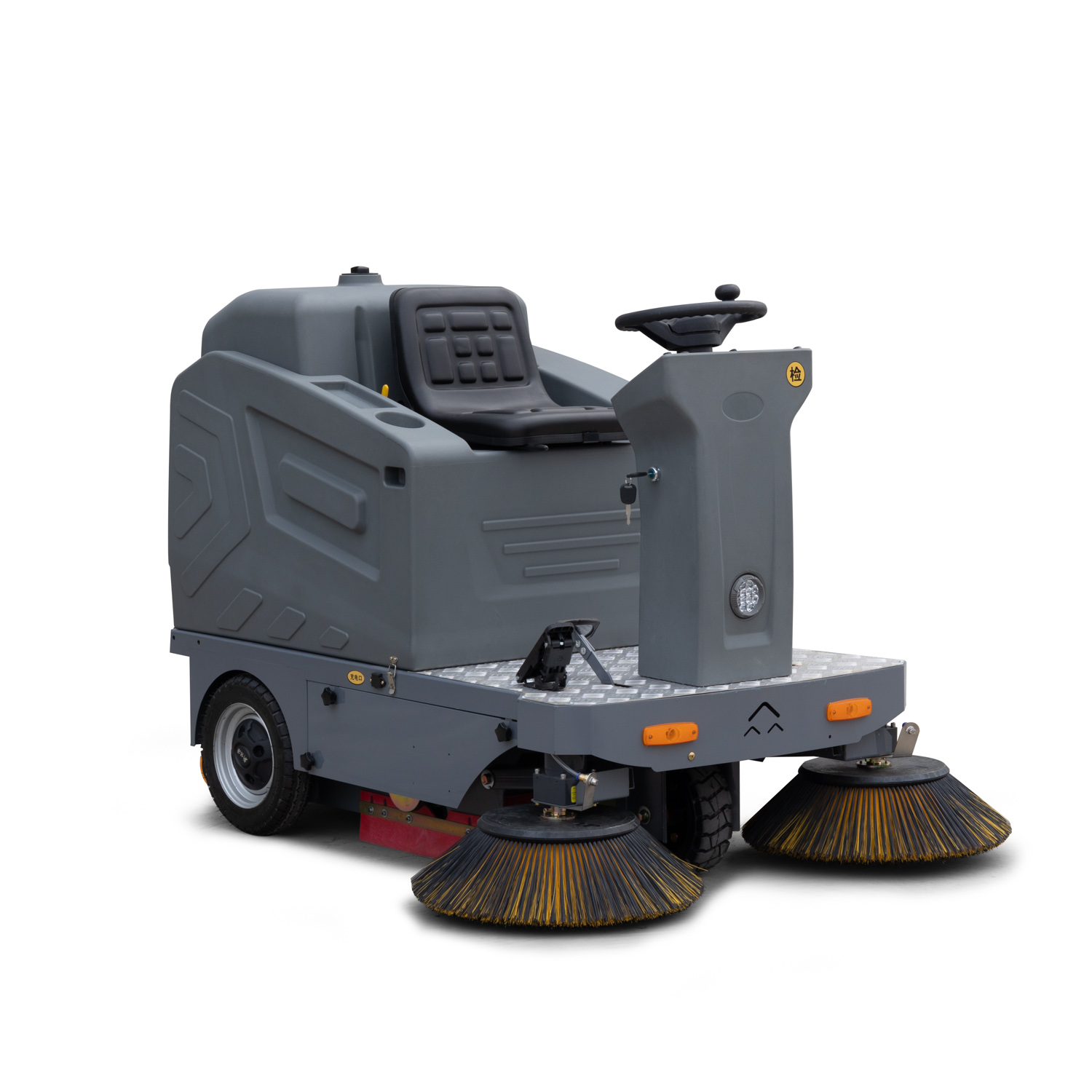
If you’re specifying cleaning equipment for a manufacturing site, the wrong ride-on sweeper fails in predictable ways: it doesn’t fit the route, it throws fine dust back into the air, or it spends more time being emptied and serviced than sweeping.
This guide is written for a procurement mindset. The goal isn’t to pick “the best” machine. It’s to write a spec that survives vendor claims, site reality, and audit questions.
If your team uses the term ride-on floor sweeper internally, that’s the same category we’re addressing here. The difference is we’re treating it like a specification problem, not a catalog choice.
Quick comparison: what to evaluate (and what to verify)
What you’re evaluating | What to ask for (documentation) | What to verify on-site |
|---|---|---|
Sweeper mechanism (direct-throw vs overthrow/vacuum-assisted) | Collection system description + debris suitability | Run it on your worst debris mix: fine dust + metal shavings |
Dust containment & filtration | Filter type/grade, sealing points, filter cleaning method | Watch for visible re-aerosolization while sweeping and during dumping |
Sweeping width vs route fit | Sweeping path, machine width, turning radius | Tightest aisle, tightest 90° turn, doorways, dock plates |
Hopper capacity & dumping | Hopper volume + dump method/height | Time a dump cycle, check dust release and ease of cleanup |
Power & runtime | Battery chemistry, Ah/kWh, charge time, support plan | Complete a full shift route with margin |
Maintenance & consumables | Wear parts list + intervals + spares lead time | Access panels, tool needs, daily service time |
Step 1: Start with your “duty cycle” (it drives everything)
Before comparing machines, write down five facts about the job:
Floor area and route shape: big open bays vs narrow aisles vs both.
Your top debris types: fine dust, mixed debris, metal shavings, pallet chips.
Cleaning window: during production, between shifts, or overnight.
Dust risk profile: nuisance dust vs respirable dust zones (silica, fine powders).
Dumping reality: where does debris go and how often can operators dump?
If you don’t lock these down, you end up evaluating a demo that’s tuned for a clean concrete aisle and a five-minute “looks good” pass.
Step 2: Choose the right ride-on industrial sweeper collection system
Most buyers focus on sweeping width first. In manufacturing, the collection mechanism and dust control are usually what makes a sweeper succeed or fail.
Direct-throw vs overthrow: why the mechanism matters
Two common collection principles:
Direct-throw (front/dustpan) systems throw debris straight into a front hopper. These systems are often favored for heavier debris, because the debris has a short travel path.
Overthrow (rear/top-loading) systems lift debris up and over the main broom into a rear hopper, which can pack more material by gravity. These are often positioned as better for lighter debris and fine material.
A clear overview of these two systems (and typical debris fit) is outlined in direct-throw vs overthrow sweeper systems.
For metal shavings, insist on two things
A brush system that can lift dense debris without “skipping.” Shavings that are matted into oil film or trapped in floor texture need mechanical agitation.
A dust-control system that doesn’t turn sweeping into air mixing. If the machine picks up shavings but re-aerosolizes fine dust, you’ve just moved the problem into the breathing zone.
Step 3: Treat dust containment as a compliance topic, not a cleanliness topic
If your site has respirable dust concerns, housekeeping methods can become a compliance question.
OSHA’s respirable crystalline silica standard includes a housekeeping clause that restricts dry sweeping where it could contribute to employee exposure unless safer methods are not feasible. See OSHA’s respirable crystalline silica standard (29 CFR 1910.1053).
You don’t need a lawyer to apply the practical implication: if a sweeper visibly puts fine dust back into the air, you should treat it as a safety and documentation problem.
What “good dust control” looks like in a ride-on sweeper
Look for a combination of:
Sealed dust path: the machine shouldn’t leak around the hopper, filter housing, or skirts.
Filtration that matches your dust: don’t accept vague “high efficiency” language without filter details.
A realistic filter cleaning method: shaker or auto-cleaning that keeps airflow stable under load.
Containment during dumping: sweeping is only half the story; dumping can create the biggest dust plume.
SUNBON’s checklist-style breakdown of dust containment questions is a good starting point in their industrial floor sweeper buyer’s guide.
Step 4: Sweeping width and hopper size are productivity levers, not bragging points
Manufacturing teams usually care about one number: how quickly the sweeper can finish the route without disrupting production.
Sweeping width: pick the widest path that still fits the site
A wider path covers more area, but it also:
increases turning constraints
increases edge-miss risk in cluttered areas
can force multi-point turns at aisle ends
If you want a reference point for what “large” looks like, Kärcher lists a ride-on sweeper with a 53.1-inch working width (66.9 inches with a side brush) and a very large hopper on their Kärcher KM 170/600 R D Classic specifications. Use this kind of spec page to calibrate what you’re being sold.
Hopper capacity: size it to your dumping constraints
If dumping requires a long trip, PPE changes, or access control, hopper capacity matters more than sweeping width.
Ask vendors:
hopper volume (and whether it’s usable volume)
dump method (manual, assisted, high dump)
whether dumping can be done into your actual waste containers
how the hopper is cleaned without blowing dust around
Step 5: Route fit is where “good on paper” machines fail
For a ride-on sweeper, route fit is three measurements and one observation:
Narrowest aisle/doorway the machine must pass
Tightest turn (often the aisle-end 90°)
Thresholds/ramps/dock plates that change traction and approach angle
Operator visibility while approaching cross-traffic
Pro Tip: Do your own tape-measure walk-through before the demo. Use the tightest spot on the route as the first test zone.
SUNBON’s factory-focused checklist emphasizes this “measure first” approach in their small ride-on sweeper buyer’s guide for factories.
Step 6: Power choice should follow your operating window and air rules
For manufacturing sites, the decision is rarely “battery is better” or “engine is better.” It’s whether the power choice fits your constraints.
Consider:
Indoor air rules and ventilation: combustion power may be restricted indoors.
Noise limits during production: ask for dBA values and test them in your actual space.
Charging reality: where does the machine live, and can it reliably charge?
Shift coverage: can it finish the route with margin, or will you need mid-shift charging?
If a vendor can’t explain runtime assumptions (speed, debris load, filter loading, dump frequency), treat the runtime number as marketing.
Step 7: Maintenance is a spec line item (filters and seals drive downtime)
In dust-heavy plants, “maintenance” isn’t an annual event. It’s a weekly reality.
Ask for a consumables plan that includes:
main broom and side brush wear intervals
filter cleaning procedure and replacement interval
skirt/seal inspection points
access time (how long daily service should take)
parts availability and lead times
If you want a practical troubleshooting view for common dust-control failures (clogged filters, leaks, airflow issues), SUNBON’s ride-on sweeper maintenance checklist is a good reference.
Step 8: Build a vendor comparison checklist you can use in a quote review
To compare vendors consistently, ask each to submit the same set of documents:
Datasheet (sweeping width, hopper capacity, machine dimensions, turning radius)
Filtration documentation (filter type, service method, sealing points; include any HEPA claims in writing)
Maintenance plan (daily/weekly tasks, wear parts list, recommended spares)
Warranty and service plan (response time, parts logistics, what’s excluded)
Commissioning and training plan (operator training, safety checks, handover documentation)
Then run the same demo protocol:
Route-fit test: tightest aisle, tightest turn, busiest cross-traffic zone.
Dust test: sweep the dustiest area and watch for visible re-aerosolization.
Dump test: time a full dump cycle and observe dust release.
If a machine only performs well on a clean strip, it’s not a plant-ready evaluation.
Where SUNBON fits (neutral reference)
If you want a concrete example of a wide-area ride-on sweeper configuration, you can review the SUNBON SBN-25000AW ride-on industrial sweeper. Treat this as an example page for configuration and application fit, then compare it against the criteria above.
Next steps
If you want, share three numbers and you can turn this into a one-page procurement spec:
your narrowest aisle/door width
your top three debris types
your cleaning window (minutes per shift)
SUNBON can also help you map those constraints into a short shortlist and a quote-comparison checklist, so different vendors are answering the same questions.





