
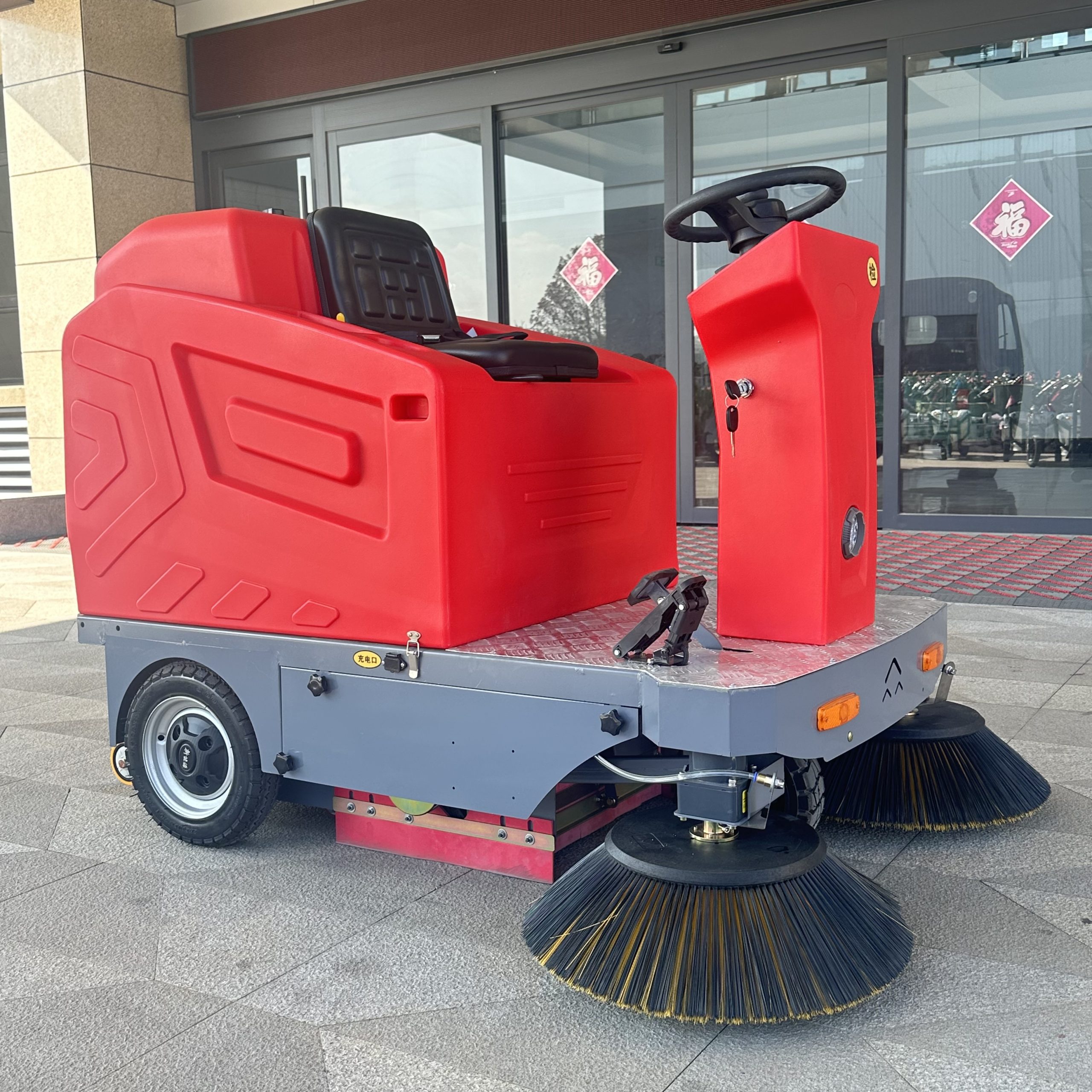
Maintaining clean, dust-free floors across large manufacturing plants, distribution hubs, and commercial centers is a persistent operational challenge. Manual push sweeping and small walk-behind sweepers quickly become bottlenecks when facility floor space exceeds 50,000 square feet. Operator fatigue sets in, dust gets re-aerosolized into breathing zones, and labor hours consume a disproportionate share of the janitorial budget.
Investing in a ride-on sweeper transforms facility maintenance by increasing cleaning productivity by up to 600%. By placing the operator in an ergonomic driving position with a wide sweeping path, multi-stage dust filtration, and heavy-duty debris collection, a single worker can clear 50,000 to over 200,000 square feet per hour.
This buyer’s guide breaks down the critical selection criteria, technical specifications, power systems, and return-on-investment (ROI) calculations facility managers need to evaluate before purchasing a ride-on floor sweeper in 2026.
Step 1: Assess Your Facility’s Cleaning Needs
Before comparing specific equipment models, facility managers should conduct a structured site evaluation. Machine selection depends directly on square footage, aisle layout, debris characteristics, and floor surface types.
Facility Size and Square Footage Thresholds
While walk-behind sweepers are adequate for smaller rooms, facility size dictates when a riding sweeper becomes financially necessary:
Under 30,000 sq. ft. (2,800 m²): Walk-behind sweepers provide sufficient maneuverability in tight storage rooms and small workshops.
30,000 to 80,000 sq. ft. (2,800–7,400 m²): Compact battery-powered ride-on sweepers significantly reduce shift times and labor expenditure.
Over 80,000 to 200,000+ sq. ft. (7,400–18,500+ m²): Heavy-duty industrial ride-on sweepers are mandatory to keep pace with daily dust accumulation, heavy traffic, and pallet debris.
According to a Plant Services equipment selection study, facilities operating over 50,000 square feet routinely recoup the higher capital investment of riding equipment in three to six months purely through reduced labor hours.
Aisle Clearance, Doorway Width, and Turning Radius
A high-capacity sweeper is only useful if it can navigate your narrowest production aisles. Measure the following dimensions prior to procurement:
Minimum Aisle Width: Ensure the sweeper’s outer frame clearance leaves at least 6 to 12 inches of buffer when passing racking or machinery.
Turning Radius: Look for front-wheel steer or zero-turn capabilities that allow 180-degree turnarounds in aisle intersections without requiring multi-point maneuvers.
Doorway and Elevator Passage: Verify overall machine height and width if the sweeper must transition between different building sectors or utilize freight elevators.
Debris Characterization and Surface Conditions
Matching the broom and filtration system to your debris profile ensures effective single-pass cleaning:
Fine Airborne Dust (Cement, Flour, Dry Chemicals): Requires high-performance vacuum suction combined with fine-particle PTFE or polyester filters and electric filter shakers.
Medium Debris (Metal Shavings, Wood Chips, Sawdust): Requires a durable cylindrical main broom with adjustable brush pressure to prevent entanglement.
Bulky Litter (Packaging Strapping, Paper, Small Pallet Splinters): Demands a wide sweeping throat and a large-capacity hopper to prevent clogging.
Pro Tip: If your facility generates both fine airborne dust and coarse debris, select a sweeper equipped with a front-spray water misting system to suppress dust at the side brooms before the main roller sweeps debris into the hopper.
Step 2: Key Ride-On Sweeper Specifications to Compare
Evaluating machine datasheets requires understanding how mechanical components interact to deliver single-pass cleaning performance.
RIDE-ON SWEEPER WORKFLOW Dual Side Brushes – → Sweeps debris into central path Main Roller Broom – → Throws debris forward into Hopper Vacuum Fan & Filter → Filters fine dust (0.3-5µm) / Clean Air Hydraulic High-Dump → Discharges waste directly into Dumpster
1. Sweeping Path Width and Productivity Calculations
The total sweeping path combines the central cylindrical broom and the reach of one or two side brooms:
Main Broom Width: Typically ranges from 28 inches (700 mm) on compact units to 40+ inches (1,000 mm) on industrial models.
Dual Side Broom Path: Extends the total cleaning width to 45–75+ inches (1,150–1,900 mm), allowing the machine to sweep flush against walls, curbs, and pallet racks.
Theoretical productivity is calculated using the standard industrial formula:
Theoretical Productivity (sq. ft./hr) = Sweeping Path (inches) × Speed (mph) × 5,280/12
In practical operation, real-world productivity is typically estimated at 60% to 75% of theoretical capacity to account for turns, operator speed adjustments, and hopper dumping. For example, commercial models listed in Kärcher industrial sweeper benchmarks demonstrate real-world coverage rates ranging from 50,000 to over 200,000 square feet per hour.
2. Dust Suppression and Filtration Systems
A common failure point in low-grade sweeping machines is dust re-aerosolization—where fine particles pass through the filter and blow back into the facility environment. Premium industrial sweepers feature three-tier dust control:
Water Mist Suppression: Front spray nozzles deposit a fine water mist over side brooms, weighing down fine particles before they are swept.
Vacuum Suction Turbine: Creates negative air pressure inside the broom chamber, pulling air through the main filtration system.
Multi-Stage Pocket / Panel Filter: High-efficiency polyester or PTFE filters capture particles down to 1–5 microns at up to 99.9% filtration efficiency. Integrated electric shakers vibrate the filter automatically to dislodge packed dust into the hopper without manual disassembling.
3. Hopper Capacity and Dumping Mechanism
Hopper volume determines how long a machine can operate before stopping to discharge waste:
Compact Manual-Dump Hoppers (15–25 Gallons / 60–90 Liters): Feature removable roll-out waste bins suitable for light-to-medium debris.
Hydraulic High-Dump Hoppers (50–120+ Gallons / 190–450+ Liters): Utilize hydraulic arms to lift the hopper up to 55–60 inches (1.4–1.5 meters), allowing the operator to dump collected waste directly into standard trash dumpsters without leaving the driving seat.
Step 3: Power Systems: Lithium-Ion vs. Lead-Acid vs. Combustion Engines
Selecting the right power architecture impacts indoor emissions, shift flexibility, and long-term total cost of ownership.
Feature / Metric | Lithium-Ion (LiFePO4) Battery | Lead-Acid / AGM Battery | LPG / Diesel Engine |
|---|---|---|---|
Indoor Emission Level | Zero emissions (100% clean) | Zero emissions | Exhaust fumes present |
Shift Runtime | 3.5 – 5+ hours per charge | 3 – 4 hours per charge | Continuous refueling |
Recharge Time | 2 – 3 hours (Fast Charge) | 8 – 10 hours + cool down | 5 minutes (refuel) |
Opportunity Charging | Allowed (top up during breaks) | Strictly forbidden (damages cells) | N/A |
Battery Maintenance | Zero maintenance required | Water topping required (Flooded) | Engine oil & filter service |
Lifespan Expectancy | 3,000+ cycles (5–8 years) | 800–1,200 cycles (2–3 years) | 5,000+ engine hours |
Best Facility Match | Multi-shift indoor warehouses | Single-shift indoor plants | Outdoor parking & logistics yards |
The Rise of Lithium-Ion Technology in Warehousing
For modern logistics centers and food-grade facilities, battery-powered sweepers are the industry standard. As highlighted in the electric sweepers for manufacturing facilities technical overview, lithium iron phosphate (LiFePO4) batteries eliminate toxic off-gassing, liquid acid maintenance, and long recharging downtime. Operators can perform opportunity charging during 15-minute shift breaks, keeping the machine ready for 24/7 continuous operations.
Manufacturer-direct equipment from Sunbon industrial floor sweepers utilizes high-performance lithium power packs combined with modular component layouts, reducing electrical maintenance overhead while ensuring stable voltage output throughout the cleaning cycle.
Commercial & Industrial Ride-On Sweeper Selection Matrix
To help streamline equipment selection, compare machine classes against your operational parameters:
Facility Parameter | Compact Electric Ride-On | Medium Industrial Ride-On | Heavy-Duty High-Dump Ride-On |
|---|---|---|---|
Facility Size Range | 30,000 – 70,000 sq. ft. | 70,000 – 150,000 sq. ft. | 150,000 – 300,000+ sq. ft. |
Sweeping Path Width | 40″ – 49″ (1,000–1,250 mm) | 51″ – 60″ (1,300–1,500 mm) | 65″ – 80″+ (1,650–2,000+ mm) |
Sweeping Efficiency | 50,000 – 80,000 sq. ft./hr | 85,000 – 130,000 sq. ft./hr | 150,000 – 235,000+ sq. ft./hr |
Power System | 48V Lithium / Lead-Acid | 48V Lithium-Ion | 48V/72V Lithium or LPG/Diesel |
Hopper Capacity | 18 – 25 Gallons (70–90 L) | 35 – 60 Gallons (130–230 L) | 80 – 130+ Gallons (300–500 L) |
Dumping Mechanism | Manual roll-out drawers | Powered / Low-Dump | Hydraulic High-Dump (60″ height) |
Primary Applications | Commercial aisles, retail | Warehousing, manufacturing | Heavy logistics, outdoor yards |
Calculating Your ROI and Labor Cost Payback
Upgrading to a riding floor sweeper is primarily a labor-efficiency investment. Comparing manual or walk-behind cleaning costs against automated ride-on operations reveals clear financial payback.
Labor Savings Comparison Scenario
Consider a 100,000 sq. ft. manufacturing warehouse swept 5 times per week (260 days per year), with a fully burdened janitorial labor rate of $25.00 per hour:
Walk-Behind Sweeper (25,000 sq. ft./hr real-world capacity): Daily Cleaning Time = 100,000/25,000 = 4.0 hours/day Annual Labor Cost = 4.0 hrs × \25/hr × 260 days = \26,000 / year
Medium Ride-On Sweeper (100,000 sq. ft./hr real-world capacity): Daily Cleaning Time = 100,000/100,000 = 1.0 hour/day Annual Labor Cost = 1.0 hr × \25/hr × 260 days = \6,500 / year
Financial Payback Summary
Direct Annual Labor Savings: \26,000 – \6,500 = \19,500 per year$
Labor Hours Reallocated: 780 worker-hours saved annually for higher-value operational tasks.
Estimated Payback Horizon: A commercial ride-on sweeper costing \8,000 to $12,000$ achieves full capital payback within 5 to 8 months of installation.
Guidance provided in the industrial floor sweeper selection guide notes that labor savings compound when accounting for reduced worker fatigue, lower workers’ compensation claims, and reduced wear on warehouse HVAC air filters due to superior dust collection.
Preventative Maintenance Protocols & Uptime Optimization
To ensure a 7 to 10-year operational service life, facility operators should follow structured preventive maintenance procedures.
DAILY MAINTENANCE CHECKLIST Inspect main broom & side brushes for wire/strapping wrap Activate electric filter shaker after each sweeping session Empty debris hopper and wipe down rubber sealing gaskets Check battery charge status & plug into fast charger
Key Service Intervals
Daily (Post-Shift): Run the electric filter shaker cycle before emptying the hopper. Inspect side brushes for plastic wrap or wire entanglement. Clean hopper sealing gaskets to preserve negative air vacuum pressure.
Weekly: Check main broom height adjustments and pattern wear. Inspect water mist spray nozzles for hard-water clogging.
Monthly: Inspect vacuum fan drive belts, verify filter seal integrity, and check tire pressure.
Following established ride-on sweeper maintenance protocols minimizes unscheduled downtime. Equipment designed with modular chassis layouts—such as Sunbon ride-on sweepers—enables technicians to swap wear parts, brushes, and electronic modules in minutes without requiring specialized factory tooling.
Frequently Asked Questions (FAQ)
Can a ride-on sweeper be operated on delicate epoxy or polished concrete floors?
Yes. Ride-on floor sweepers utilize non-marking polyurethane tires and soft polypropylene or nylon bristle brooms designed specifically for polished concrete, sealed epoxy, tile, and smooth warehouse floors. Main broom ground pressure can be adjusted to clean surface dust without scratching glossy floor coatings.
What is the difference between a ride-on sweeper and a ride-on scrubber?
A floor sweeper uses dry rotating brushes and vacuum suction to collect dry debris, dust, litter, and metal shavings into a dry hopper. A floor scrubber applies water and detergent, scrubs the floor with pads or disk brushes, and vacuums up wet slurry into a recovery tank. Facilities with heavy dry dust should always sweep before scrubbing to prevent wet mud from clogging scrubber squeegees.
How often should the main dust filter be replaced?
Under normal warehouse operating conditions, high-efficiency polyester or PTFE filters last between 12 and 24 months. Utilizing an automated electric filter shaker after every shift prevents fine dust from caking, maintaining maximum airflow and extending filter life.
Are electric ride-on sweepers powerful enough for outdoor parking lots?
Modern 48V electric sweepers equipped with lithium batteries deliver sufficient torque to handle outdoor asphalt, concrete parking bays, and loading docks. They handle gravel, leaves, paper, and light debris with ease. However, for continuous heavy gravel or severe outdoor off-road conditions, high-displacement LPG or diesel units may be preferred.
Next Steps: Selecting the Right Ride-On Sweeper
Choosing the ideal ride-on floor sweeper requires balancing your facility’s square footage, aisle layout, debris load, and budget. By shifting from labor-intensive manual sweeping to a high-capacity electric riding sweeper, facility managers secure cleaner air, safer working conditions, and significant labor cost savings.
To explore customized floor cleaning machinery, technical specifications, and factory-direct pricing tailored to your site requirements, consult with the cleaning engineering team at Sunbon industrial floor sweepers.





