
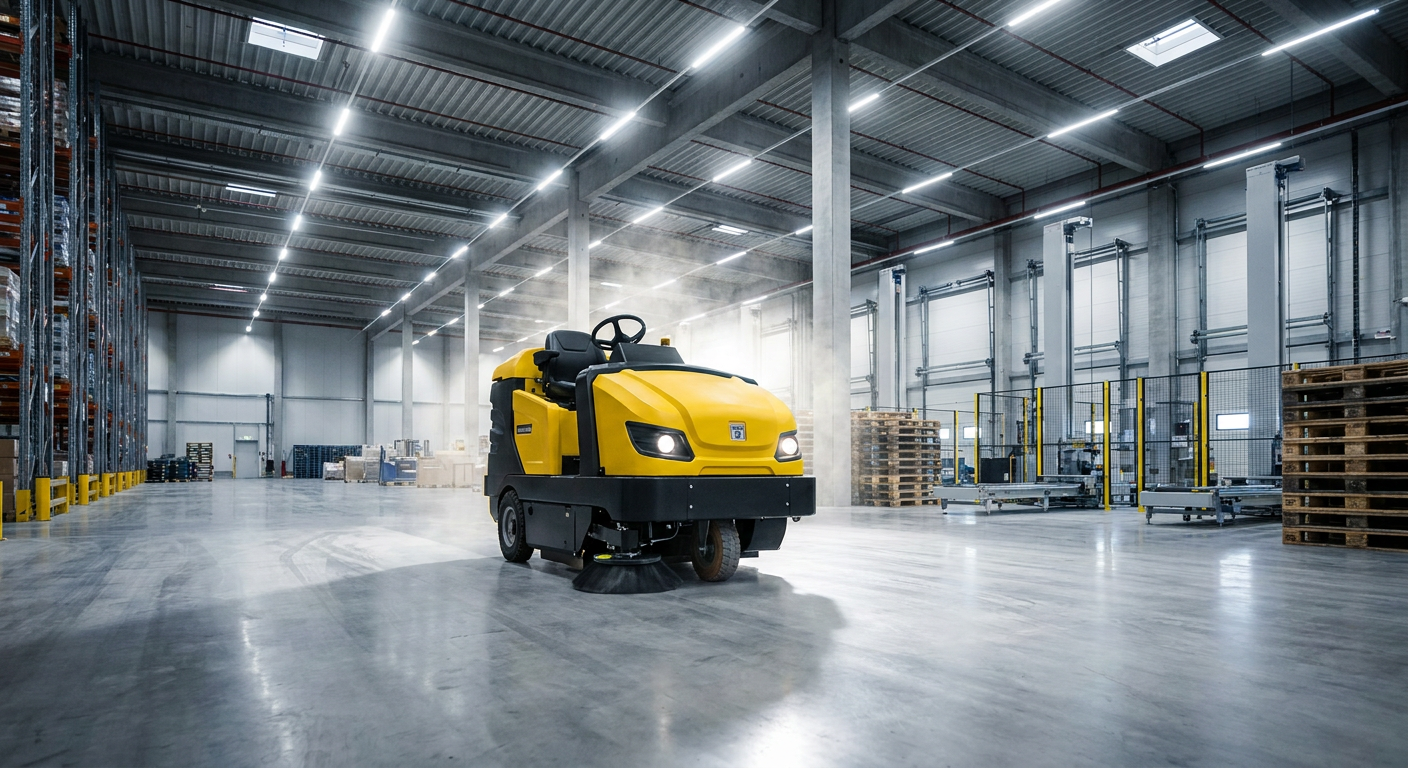
In a 100,000-square-foot manufacturing plant or logistics distribution center, floor cleanliness is rarely just an aesthetic preference. Fine concrete dust, metal shavings, wood splinters, packaging scraps, and outdoor grit continuously accumulate in high-traffic aisles. When swept manually with push brooms, fine particulates remain airborne for hours, settling directly onto precision machinery, circuit boards, and finished inventory while creating severe slip-and-fall hazards for forklift operators.
Transitioning from manual floor maintenance to a dedicated industrial sweeper increases daily cleaning productivity by 3000% to 4000% while capturing airborne dust at the brush head. However, selecting the wrong equipment—such as an underpowered walk-behind unit for a multi-shift logistics hub, or a wide ride-on machine that cannot navigate 6-foot racking aisles—leads to costly operational bottlenecks, frequent battery degradation, and equipment downtime.
This 2026 buyer’s guide provides facility managers, operations directors, and plant engineers with an engineering-grade evaluation framework. We examine machine classifications, essential technical benchmarks, lithium-ion battery architectures, airborne dust filtration standards, and Total Cost of Ownership (TCO) calculations.
1. Industrial Sweeper Classifications: Walk-Behind vs. Ride-On
Matching an industrial sweeper to your site requires analyzing four core variables: daily cleanable square footage, minimum aisle width, debris weight, and available cleaning windows per shift. Understanding industrial floor sweeper fundamentals begins with classifying machines by drive type and operating footprint.
Key Takeaway: Always select machine capacity based on your active cleaning window rather than total plant square footage. A 100,000 sq ft warehouse with a strict 45-minute daily cleaning window requires the hourly throughput of a large ride-on sweeper, not a compact walk-behind model.
Industrial Floor Sweeper Category Comparison
Specification / Parameter | Walk-Behind Industrial Sweeper | Compact Ride-On Floor Sweeper | Heavy-Duty Industrial Ride-On |
|---|---|---|---|
Cleaning Path (Width) | 700 – 1,050 mm (28–41 in) | 1,200 – 1,500 mm (47–59 in) | 1,800 – 2,200 mm (70–86 in) |
Hopper / Waste Bin Capacity | 35 – 60 L (1.2–2.1 cu ft) | 80 – 150 L (2.8–5.3 cu ft) | 180 – 260+ L (6.3–9.2 cu ft) |
Theoretical Efficiency | 3,000 – 5,000 m²/h (32,000–53,000 ft²/h) | 7,000 – 12,000 m²/h (75,000–129,000 ft²/h) | 15,000 – 22,000+ m²/h (160,000–236,000 ft²/h) |
Minimum Aisle Width | < 2.0 m (6.5 ft) | 2.0 – 2.5 m (6.5–8.2 ft) | > 3.0 m (9.8 ft) / Open thoroughfares |
Target Facility Size | Up to 30,000 sq ft | 30,000 – 150,000 sq ft | 150,000+ sq ft / Outdoor yards |
Primary Operator Position | Pedestrian (Self-propelled) | Seated (Compact chassis) | Seated (Enclosed / Heavy chassis) |
Walk-Behind Industrial Sweepers
Walk-behind floor sweepers feature self-propelled drive motors and narrow operating widths. They excel in tight operational zones, congested assembly lines, mezzanine floors, and narrow storage aisles where ride-on machinery cannot turn. Because pedestrian operators can easily navigate around pallets and structural columns, walk-behind sweepers provide precision cleaning for small-to-medium manufacturing bays and toolrooms.
Compact & Large Ride-On Floor Sweepers
For facilities exceeding 30,000 square feet, ride-on sweepers dramatically reduce operator fatigue while increasing linear speed up to 8–12 km/h (5–7.5 mph). Equipped with wide main cylindrical brushes and dual side disc brushes, compact ride-on machines sweep large logistics lanes in a single pass. When evaluating high-throughput logistics hubs or heavy manufacturing sites, reviewing a dedicated factory and warehouse floor care equipment guide helps establish the proper ratio between sweeping path width and hopper dump frequency.
2. Essential Technical Specifications & Benchmark Metrics
When comparing equipment spec sheets, marketing labels like “heavy-duty” or “ultra-efficient” provide little value. Operations managers must evaluate six verified engineering metrics to ensure long-term durability.
Industrial Sweeping System Flow:
Side Brushes (Sweep edges into path) ➔ Main Cylindrical Brush (Throws debris into hopper) ➔ Vacuum Fan (Pulls fine dust) ➔ Pocket/HEPA Filter (Traps micro-particulates)
1. Cleaning Path Width & Brush System Architecture
The total cleaning path consists of the main cylindrical brush width plus the reach of one or two side disc brushes. The side brushes extend beyond the machine chassis to pull dust away from walls, rack bases, and machinery edges, feeding debris directly into the path of the main broom. Look for adjustable brush pressure settings (30–50 kg benchmark) to handle both smooth polished concrete and rough, uneven asphalt.
2. Hopper Capacity & High-Dump Systems
Hopper volume dictates how many times an operator must stop work to empty debris. Compact units feature manual pull-out drawer bins (35–60 L), while heavy-duty ride-on machines incorporate hydraulic high-dump mechanisms. High-dump systems elevate the hopper up to 1.5 meters (5 feet), allowing operators to discharge 150–250 liters of heavy debris directly into standard industrial dumpsters without manual lifting.
3. Vacuum Suction Airflow & Dust Suppression
A sweeper without strong vacuum airflow is merely a motorized broom that spreads airborne dust. Look for a minimum suction airflow rating of 1,000+ m³/h driven by a dedicated vacuum motor. High-performance industrial sweepers feature atomized water misting systems above the side brushes to suppress dust plumes before the brushes make contact with fine concrete powder.
Pro Tip: Ensure the main brush chamber uses flexible rubber skirts that maintain zero-ground clearance. Worn or torn chamber skirts destroy vacuum negative pressure, causing fine dust to escape from the sides during high-speed sweeping.
3. Power Architecture: Maintenance-Free Lithium-Ion vs. Lead-Acid
Power plant selection directly influences shift uptime, daily maintenance overhead, and long-term battery replacement costs. While legacy industrial sweepers relied on flooded lead-acid batteries, modern facilities are rapidly standardizing on maintenance-free Lithium-Ion (LiFePO4) battery packs.
Battery Cycle Life Comparison | Detail |
|---|---|
Lithium-Ion (LiFePO4) | 2,500 – 3,000+ Cycles (5-8 Years) |
Lead-Acid (AGM/Flooded) | 500 – 800 Cycles (1.5-3 Years) |
Performance & Lifecycle Comparison
Operating Parameter | Maintenance-Free Lithium-Ion (48V) | Traditional Flooded Lead-Acid |
|---|---|---|
Useful Lifecycle (80% DOD) | 2,500 – 3,000+ Deep Cycles | 500 – 800 Cycles |
Routine Maintenance | Zero (Sealed BMS Protection) | Weekly distilled water topping & acid cleaning |
Recharge Duration | 2 – 3 Hours (Fast Charge) | 8 – 10 Hours + 8 Hour cooling period |
Opportunity Charging | Supported (Charge during 30-min breaks) | Strictly prohibited (Causes thermal damage) |
Multi-Shift Capability | 24/7 continuous operation with 1 battery | Requires spare battery swapping or extra machines |
Energy Conversion Efficiency | > 95% | ~ 70–75% (High heat loss during charging) |
Why Lithium Battery Architecture Wins in Industrial Settings
Opportunity Charging Support: Lithium-ion batteries accept high-current rapid charging without battery memory degradation. Operators can plug the sweeper in during lunch breaks or shift changes, extending 4–6 hours of continuous runtime into 24/7 multi-shift availability.
Elimination of Maintenance Labor: Flooded lead-acid batteries require janitorial staff to regularly top off cell water with distilled water and neutralize terminal acid corrosion. Missing a single watering window permanently ruins lead-acid cells, leading to thousands of dollars in premature replacement costs.
Constant Voltage Output: Unlike lead-acid batteries that experience voltage drop as they discharge (causing brush speeds and suction power to fade halfway through a shift), lithium batteries maintain 100% rated power output until fully depleted.
4. Dust Filtration & OSHA Air Quality Compliance
In manufacturing environments involving concrete grinding, foundry operations, brick making, or logistics, dry sweeping generates respirable crystalline silica dust. Under the United States Occupational Safety and Health Administration regulations (OSHA 29 CFR 1910.1053), facilities must implement engineering controls to limit worker exposure to airborne silica dust.
Multi-Stage Dust Control Architecture:
Water Misting Nozzles ➔ Suppresses heavy ambient dust at side brushes
Main Brush Chamber Skirts ➔ Seals vacuum zone to prevent lateral dust escape
Polyester Pocket Filter / HEPA H13 ➔ Traps 99.9% of micro-particulates down to 0.3 microns
Electric Filter Shaker ➔ Automated vibration clears filter pleats into hopper
Multi-Stage Filtration Architecture
Industrial sweepers achieve air quality compliance using a two-stage collection process:
Stage 1 (Mechanical Separation): Heavy debris, metal chips, and gravel drop directly into the hopper via gravity and main brush rotation.
Stage 2 (Micro-Particulate Filtration): The vacuum turbine pulls fine dust through a multi-pocket polyester filter or HEPA H13 cartridge. High-grade polyester media filters trap 99.9% of airborne particles down to 3 microns, while optional HEPA filters capture particles as small as 0.3 microns.
⚠️ Operational Risk: Never wash polyester pocket filters with high-pressure water guns unless explicitly specified by the manufacturer. Water pressure tears the micro-fiber weave, creating microscopic holes that allow fine abrasive dust to pass straight into the vacuum turbine motor, destroying it within weeks.
Automated Electric Filter Shakers
As fine dust coats the filter surface, airflow resistance increases, causing suction pressure to drop. Premium industrial sweepers integrate an automated electric filter shaker. At the push of a button—or automatically when the sweeping drive is turned off—an electric motor vibrates the filter frame, knocking dust cake off the pleats directly into the waste hopper. This ensures consistent suction performance throughout long operational shifts without requiring operators to manually open the filter chamber.
5. Total Cost of Ownership (TCO) & Labor ROI Calculation
While the purchase price of an industrial sweeper is an upfront capital expenditure, labor hours represent over 80% of total lifetime floor maintenance costs. Replacing manual push sweeping with a high-capacity machine yields rapid, quantifiable financial returns.
The Labor Productivity Delta
Manual Push Sweeping: 1 worker with a broom covers approximately 2,500 sq ft per hour.
Walk-Behind Sweeper (36″ path): 1 operator covers approximately 35,000 sq ft per hour (14x faster).
Ride-On Industrial Sweeper (55″ path): 1 operator covers approximately 90,000 sq ft per hour (36x faster).
Labor ROI Calculation Formula
To calculate annual labor savings for your facility, apply this formula:
Annual Labor Savings ($) = ( Facility Area/Manual Rate – Facility Area/Machine Rate ) × Daily Cleanings × Labor Rate × Working Days
Where:
Facility Area: Cleanable floor space (e.g., 60,000 sq ft)
Manual Rate: 2,500 sq ft/hr
Machine Rate: 90,000 sq ft/hr (Compact Ride-On Sweeper)
Labor Rate: Fully burdened janitorial labor cost (e.g., $24.00/hr)
Working Days: 250 operational days per year
Real-World Payback Example
In a 60,000 sq ft facility cleaned once daily:
Manual Sweeping: 60,000 / 2,500 = 24 labor hours per day ($576.00/day ➔ $144,000/year).
Ride-On Sweeper: 60,000 / 90,000 = 0.67 labor hours per day ($16.08/day ➔ $4,020/year).
Net Annual Labor Savings: $139,980.00 per year.
For a heavy logistics or industrial site requiring maximum sweep width and high daily speed, deploying a large-capacity ride-on industrial sweeper typically repays its full capital purchase price within 3 to 5 months of deployment.
6. Facility Manager Selection Checklist & Decision Framework
Before committing capital budget to a new floor sweeper, review this six-point operational checklist:
Verify Aisle Clearance & Turning Radius: Measure your narrowest storage aisles, doorway clearance heights, and turning space at rack ends. Ensure the sweeper’s outer turning radius is at least 300 mm (12 inches) narrower than your tightest aisle junction.
Audit Debris Types & Weight: Identify your top three floor contaminants. Fine cement dust and powder require high suction and polyester pocket filters; heavy metal turnings or outdoor gravel require steel-reinforced main brooms and high-torque brush motors.
Select the Right Power Chemistry: For indoor logistics and multi-shift manufacturing, specify a 48V Lithium-ion battery system with an onboard or fast external charger. Avoid flooded lead-acid batteries unless dedicated battery-maintenance staff are available.
Evaluate Modular Component Access: Choose equipment designed with modular quick-release panels. Main cylindrical brushes and side brooms should be replaceable tool-free in under 5 minutes to minimize routine maintenance downtime.
Review Spare Parts & Local Warranty Support: Inquire about spare part availability (wear brushes, squeegees, drive belts, and filters). Working with manufacturers who maintain direct spare parts stock and full technical support guarantees high operational uptime. Consulting a comprehensive industrial floor sweeper maintenance guide ensures your maintenance team understands daily inspection protocols before delivery.
Confirm Operator Training Requirements: Select sweepers featuring simple, intuitive control dashboards (single-button start, clear battery SOC indicator, emergency stop). Low control complexity allows new janitorial staff or warehouse operators to master machine operation in under 15 minutes.
Frequently Asked Questions (FAQ)
What is the main difference between an industrial floor sweeper and a floor scrubber?
An industrial floor sweeper is engineered for dry debris collection and dust control, using rotating brushes and vacuum suction to gather dust, sand, metal shavings, and trash into a hopper. A floor scrubber is designed for wet floor washing and liquid recovery, applying water and detergent solution to scrub away grease, oils, and tire marks before vacuuming dirty water into a recovery tank. For dust-heavy sites, floor sweeping should always precede scrubbing to prevent wet mud from clogging scrubber squeegees.
How often should the main brush and side brushes be replaced on an industrial sweeper?
Under standard concrete warehouse conditions, high-density nylon/polypropylene main cylindrical brushes typically last between 300 to 500 operating hours. Sweeping highly abrasive surfaces like rough asphalt or metal turnings increases wear, reducing lifespan to 150–200 hours. Brushes should be inspected weekly and replaced when broom bristles wear down by more than 30% of their original length.
Can an electric ride-on floor sweeper operate outdoors in rain or wet conditions?
Electric floor sweepers are primarily designed for dry and slightly damp debris. Operating in standing water or heavy rain can saturate the dust filter media, causing wet mud to blind the filter pleats and destroy vacuum airflow. For outdoor parking lots and loading docks, rain misting systems are acceptable, but deep puddles and standing water should be avoided.
How long does a 48V lithium-ion battery run on a single charge during heavy sweeping?
A commercial 48V / 100Ah to 200Ah lithium-ion battery pack provides between 4 to 6 hours of continuous sweeping under full load (main brush, side brushes, and vacuum fan active). Because lithium-ion batteries support rapid opportunity charging, plugging the machine in during a 30-minute shift break adds 1.5 to 2 hours of additional runtime, easily covering multi-shift operations.
Optimize Your Facility Floor Operations Today
Choosing the right industrial sweeper transforms facility hygiene, protects sensitive machinery from abrasive dust, and eliminates tens of thousands of dollars in annual manual janitorial labor.
Whether you operate a 25,000 sq ft assembly plant or a multi-building logistics park, our application engineers are ready to help you select the exact equipment specification, battery architecture, and brush configuration for your site.
Contact Sunbon Equipment Specialists today to request a free facility floor care audit, download detailed technical spec sheets, or receive a factory-direct quotation.





