
If you’re seeing dust trails along forklift lanes, debris building up under racking, or slip hazards near dock doors, you don’t have a “cleaning” problem—you have an operations risk.
A ride-on sweeper is often the fastest way to reduce that risk across large areas without burning labor hours. But it’s also easy to buy the wrong machine: too big for your aisles, under-filtered for your dust, or mismatched to your charging window.
This buyer’s guide is written for warehouses and distribution centers (US). It’ll help you do a quick needs assessment, understand the major sweeper types, and build a shortlist of evaluation criteria you can use with any vendor.
Quick decision table: what matters most in a warehouse or DC
Use this as a first-pass filter before you compare brands.
Your reality on the floor | Prioritize | Why it matters | What to ask vendors |
|---|---|---|---|
Fine dust, visible haze, or dust that ends up back on shelves | Filtration + dust control | Dust control is the difference between “looks clean” and “stays clean” | Filter type, filter area, auto-cleaning method, dust suppression/misting options |
Packaging scraps, pallet chips, leaves/sand at doors | Brush aggressiveness + hopper capacity | Bigger debris loads can overwhelm small hoppers and light brush systems | Main broom type, side brooms, hopper volume and dump method |
Tight aisles, many turns, congested pick zones | Maneuverability | A wide machine that can’t turn wastes time and causes damage | Turning radius, machine width, edge cleaning ability |
Short off-shift cleaning windows | Productivity + uptime | You’re buying time back, not just “a machine” | Claimed area coverage, runtime per charge, swap/charge strategy |
Multi-site rollout | Standardization + serviceability | Training and parts availability make or break fleet uptime | PM schedule, consumables lead time, service model, warranty terms |
Pro Tip: Before you look at model brochures, map one “typical route” in your facility (start point → choke points → turns → debris hotspots → dump point → charging spot). The best spec sheet in the world won’t fix a route that doesn’t work.
Ride-on floor sweeper vs walk-behind: a quick rule of thumb
If your sweeping routes are long, open runs and operator walking time is turning into a labor cost, a ride-on floor sweeper usually pays off. If your routes are mostly tight aisles, obstacle-heavy zones, or short stop-and-go paths, a walk-behind (or a smaller unit) often performs better day-to-day.
This “walk-behind vs ride-on sweeper” decision gets easier once you map your longest route and your narrowest aisle.
If you’re shopping specifically for a warehouse ride-on sweeper, be strict about route fit: the machine has to clear your narrowest aisle and still turn cleanly at the end of the run—or you’ll lose most of the productivity advantage to multi-point turns and rework.
As a simple benchmark, Tennant notes walk-behind sweepers are often a fit for spaces under about 4,000 sq ft, with ride-on sweepers designed for larger facilities like warehouses and manufacturing (see Tennant’s guide to understanding commercial floor sweepers).
What a ride-on sweeper is (and what it isn’t)
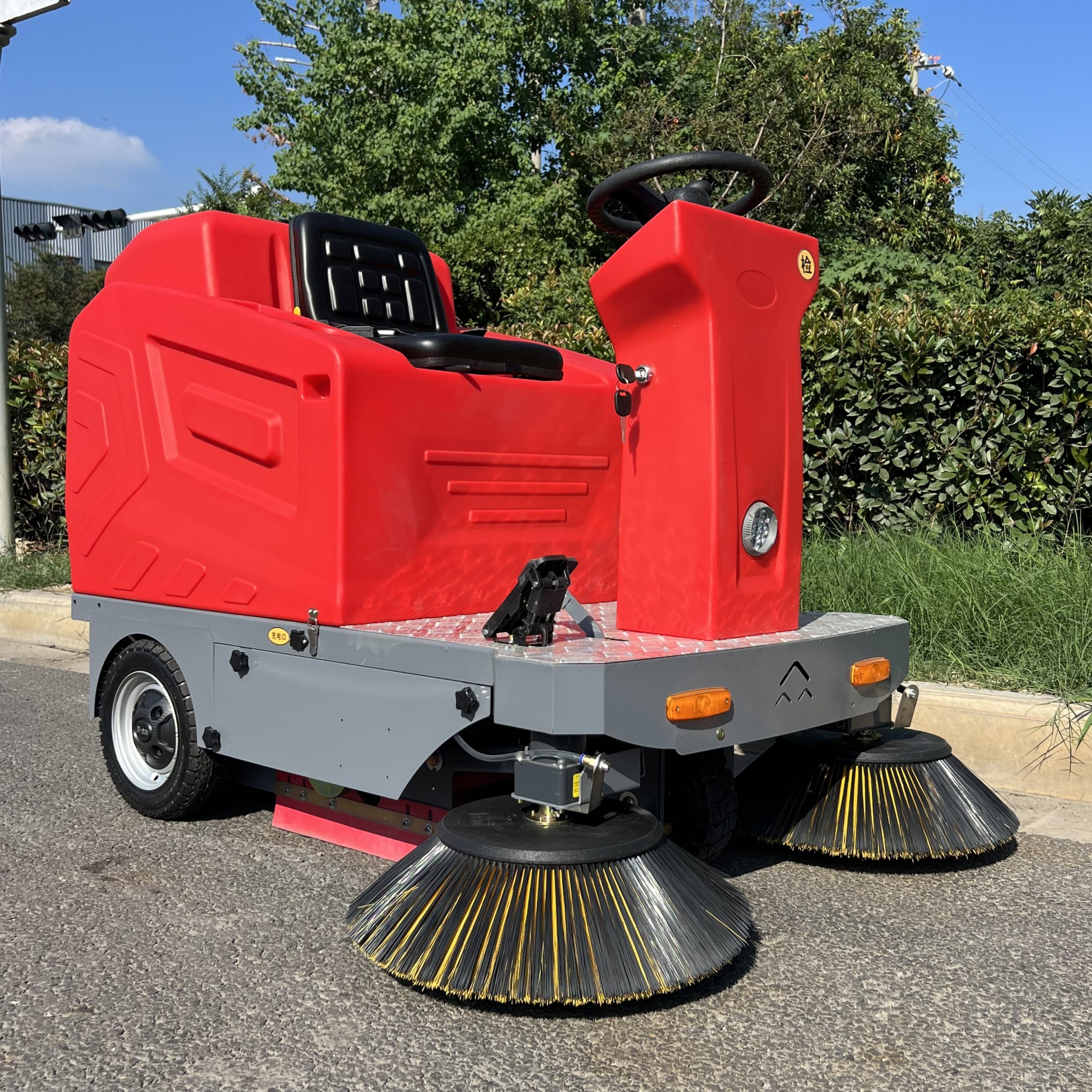
A ride-on sweeper is a powered machine the operator drives while seated. It picks up dry debris—dust, grit, packaging scraps—using a combination of brushes (to pull debris in) and a vacuum/filtration system (to contain fine particles). Many models also use dust suppression (such as misting) to reduce airborne dust.
What it isn’t: a floor scrubber.
Use a sweeper when your issue is dry debris and dust.
Use a scrubber when your issue is soil films, oily residues, sticky marks, or anything that needs washing and drying.
A lot of facilities end up needing both—but not necessarily in the same machine.
Step 1: Do a 15-minute needs assessment before you shop
Most “bad sweeper buys” trace back to skipping this step.
1) Document your debris profile
Write down your top three debris types. Be specific.
Examples you’ll see in warehouses/DCs:
pallet wood chips
shrink wrap strings that tangle
cardboard scraps
fine dust (concrete dust, powdery product residue)
sand/grit tracked in at dock doors
Why this matters: fine dust is a filtration problem. Bulky scraps are a brush and hopper problem. A machine that’s great at one can be frustrating at the other.
2) Measure your geometry (don’t guess)
You don’t need CAD drawings—just three measurements:
narrowest aisle width the machine must run
tightest turning spot (end of aisle, around a column, near staging)
any doorways/ramps/elevators the unit must pass through
If you can’t clear your tightest choke point without multiple-point turns, you’re buying a productivity leak.
3) Confirm your operating window and staffing reality
Write down:
minutes per shift you can actually sweep without disrupting production
shifts per day and days per week
who will operate the machine (dedicated cleaner vs “whoever is available”)
A ride-on floor sweeper doesn’t save money if it sits because no one’s trained, or because the charging area is always blocked.
4) Note any EHS constraints around dust
If your site handles fine particulates, document:
dust-sensitive zones (food packaging, electronics, pharma, or anywhere contamination is a risk)
visibility and respiratory concerns
housekeeping rules tied to safety audits
In some cases, dry sweeping can create exposure risk. OSHA’s general industry silica standard includes housekeeping restrictions that limit dry sweeping/dry brushing when it could contribute to exposure (see OSHA 29 CFR 1910.1053 housekeeping requirements). That doesn’t mean “you must buy X,” but it does mean dust control can’t be an afterthought.
Step 2: Dust control and filtration (where many purchases go wrong)
Warehouses often underestimate how much dust a sweeper can re-release if filtration is weak or poorly maintained.
Filtration approach and maintenance
Ask vendors:
What filter type is standard (panel, cartridge, HEPA option)?
How is the filter cleaned (manual shaker, automatic, pulse system)?
What’s the replacement cost and expected interval?
If you’re sweeping fine dust, vendor pages often recommend higher-efficiency filtration options. For example, Nilfisk highlights dust-control and filtration considerations in its category overview (see Nilfisk’s ride-on sweeper selection factors).
⚠️ Warning: Treat “HEPA” like a spec, not a marketing label. Confirm the rating and, just as important, how well the machine seals dust through the whole airflow path.
Dust suppression (misting/spraying)
If dust plumes are your problem, dust suppression can help—but it’s not magic.
Use it when:
the dust is ultra-fine and tends to go airborne
you’re sweeping near dock doors where outside grit is dry
you need to reduce airborne particles in traffic lanes
Avoid it when:
your floor becomes slick with moisture
you’re sweeping debris that turns into paste
Your goal is controlled dust, not a wet floor hazard.
Step 3: Productivity isn’t just cleaning width—it’s your whole cycle
A ride-on floor sweeper only “wins” if the whole cleaning cycle is efficient.
Cleaning path and real throughput
Instead of asking “How many square feet per hour?”, ask:
How long to sweep my actual route at safe speed?
How does performance change when the hopper fills or filters load up?
If you can, time a demo in your most realistic route.
Hopper capacity and dump logistics
Hopper size matters most on your dirtiest days.
Ask:
How often will I need to dump with pallet debris and cardboard?
Is it tool-free to dump and clean?
Where will the debris go (dumpster, compactor area), and can you get there safely?
A big hopper is only valuable if dumping is safe and doesn’t create a traffic problem.
Step 4: Maneuverability and site geometry
Warehouses and DCs don’t fail you in wide open spaces—they fail you at choke points.
What to measure and confirm
Confirm these in a demo (not just a brochure):
turning radius at the end of your tightest aisle
edge cleaning ability under racking overhangs
visibility to pedestrians and cross-traffic
Key Takeaway: A ride-on only saves labor if it can run your entire route without getting bottlenecked by aisles, doors, or turns.
Step 5: Power and charging strategy (battery vs fuel, lithium vs lead-acid)
In most indoor warehouses, battery units are the default because they’re quiet and avoid emissions in enclosed spaces.
Battery vs fuel (practical view)
Ask:
runtime under your debris load
charge time (and whether opportunity charging is OK)
electrical requirements and where the charger will live
Lithium vs lead-acid (how to think about it)
Lithium batteries can reduce maintenance and simplify opportunity charging in some setups, but your team will care about:
safety controls and battery management
charging discipline
service support if a battery module fails
If your operation runs tight off-shift windows, charging reality is often the deciding factor.
Step 6: Durability, maintenance, and serviceability (the real TCO drivers)
A sweeper that’s down is worse than manual sweeping.
Consumables and maintenance tasks
Plan for:
broom wear and replacement
filter cleaning/replacement
belts and seals
daily hopper cleanout
Simple access to common service points is a buying criterion.
Service model and parts availability
Ask blunt questions:
Where are the common parts stocked?
Typical lead times for brushes/filters and critical components?
Who does warranty work and how fast?
As an example of what “clear” looks like, SUNBON states a one-year warranty and remote support options on its product pages (see SBN-2200AW ride-on sweeper details).
What to ask for in a demo (and how to compare quotes)
Demo request checklist
Ask to demo in your three “hard zones”:
narrowest aisle + tightest turn
dust-sensitive zone
dock-door grit zone
During the demo, verify:
no visible dust plume behind the machine
debris pickup on pallet chips + shrink wrap strings
dump process (time it; check for mess)
operator visibility and safe controls
Quote comparison checklist (copy/paste)
Use this to compare vendors apples-to-apples:
machine width and turning radius (measured on site)
cleaning path width and edge cleaning reach
hopper volume and dump method
filtration type and cleaning method
dust suppression options
runtime on your route + charge time
consumables cost (brooms/filters) and intervals
warranty terms + service response model
parts lead times and training support
Examples of ride-on sweeper configurations (optional reference)
If you want a concrete starting point, SUNBON provides several ride-on sweeper configurations you can use as examples when comparing specs:
SUNBON (brand overview and product range)
Wide-area productivity claims and lithium positioning on the SBN-25000AW industrial ride-on sweeper specs
Large cleaning width and debris capacity positioning on the SBN-2450CX pure suction ride-on sweeper specifications
FAQ
How do I know if I need a ride-on sweeper or a walk-behind?
If your sweep routes are long and repeatable, and walking time is becoming your biggest labor cost, ride-on usually wins. If your routes are tight and obstacle-heavy, walk-behind often stays faster in real cycle time.
Do I need HEPA filtration?
If you’re dealing with fine dust that creates visible haze or settles back on shelves, higher-efficiency filtration is worth evaluating. Confirm the rating and sealing, and test it in your dustiest zone.
Can a ride-on sweeper replace manual sweeping completely?
Usually not. Most sites still need manual spot cleanup and edge work. The win is taking the bulk route off manual labor so manual work becomes “detail,” not “everything.”
What’s the biggest buying mistake?
Buying a ride-on floor sweeper that can’t run the full route (aisles/turns/doors) without bottlenecking. The spec sheet looks great, but the route performance collapses.
Next steps
If you’re ready to shortlist:
Measure your narrowest aisle and tightest turn.
Write your top 3 debris types.
Pick 2–3 “must win” criteria (usually dust control + route fit + uptime).
If you want, SUNBON can help you sanity-check specs against your constraints before you schedule demos—so you don’t waste time testing machines that won’t fit your routes.





