
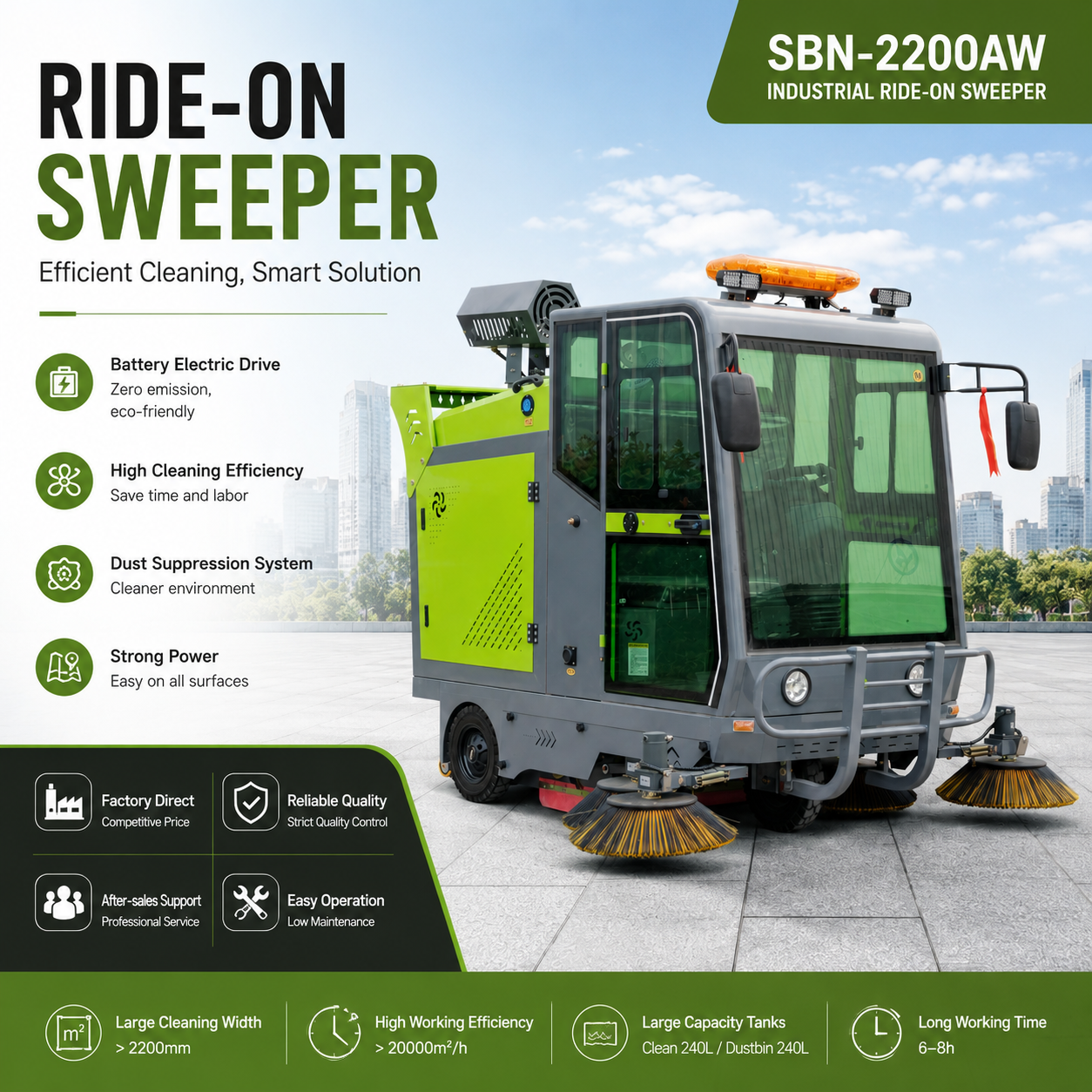
Floor cleanliness in manufacturing plants, distribution centers, and commercial warehouses directly influences operational safety, equipment longevity, and labor overhead. Manual sweeping with brooms is slow, labor-intensive, and pushes fine silica particulate into the air where it settles on sensitive machinery, electronic controls, and inventory.
Transitioning to a dedicated industrial floor sweeper allows operations managers to clean tens of thousands of square feet per hour while capturing airborne dust. However, selecting the right machine requires evaluating facility geometry, debris mix, power architecture, dust filtration, and total cost of ownership (TCO).
This buyer’s guide breaks down the core machine classifications, technical specifications, battery options, and financial ROI models needed to choose the optimal industrial sweeper for your facility.
1. Facility Sizing & Machine Classification: Walk-Behind vs. Ride-On vs. Autonomous
Matching sweeper capacity to facility square footage prevents two major purchasing mistakes: buying an undersized machine that stalls cleaning schedules, or overspending on an oversized unit that cannot navigate narrow aisles. Understanding floor sweeper fundamentals and core functions helps clarify how sweeping width and hopper capacity align with facility layouts.
According to established industrial floor sweeper evaluation standards, equipment performance falls into three primary machine categories.
Walk-Behind Industrial Floor Sweepers
Walk-behind sweepers are operator-guided machines featuring powered brush rotation and traction drive. The operator steers from behind while walking at a standard pace (2 to 3 mph).
Cleaning Width: 20 to 35 inches (500 to 900 mm).
Hourly Coverage: 20,000 to 35,000 sq ft/hr (1,800 to 3,200 m²/hr).
Hopper Capacity: 10 to 20 gallons (35 to 75 liters).
Best Fit: Facilities under 25,000 sq ft, congested packaging lines, narrow warehouse aisles under 6 feet wide, and multi-level buildings requiring elevator transport.
Ride-On Industrial Floor Sweepers
Ride-on sweepers feature a seated operator station with automotive-style steering, pedal acceleration, and wide sweeping paths. They are engineered for continuous, large-scale debris removal across expansive plant floors.
Cleaning Width: 35 to 60+ inches (900 to 1,500 mm).
Hourly Coverage: 50,000 to 120,000+ sq ft/hr (4,500 to 11,000 m²/hr).
Hopper Capacity: 25 to 100+ gallons (95 to 380 liters) with hydraulic high-dump capability.
Best Fit: Warehouses and logistics hubs over 25,000 sq ft, long transport corridors, loading docks, and outdoor parking zones.
Industry benchmarks published by equipment specialists highlight that switching from a walk-behind to a ride-on unit yields a 64% labor productivity gain, allowing facility teams to finish sweeping cycles in a fraction of the time.
Autonomous & Robotic Floor Sweepers
Autonomous sweepers combine LiDAR mapping, optical sensors, and automated navigation software to sweep scheduled routes without dedicated operator supervision.
Cleaning Width: 28 to 45 inches (700 to 1,150 mm).
Hourly Coverage: 25,000 to 50,000 sq ft/hr automated.
Best Fit: 24/7 logistics centers, cleanroom perimeter zones, and facilities facing janitorial staffing shortages.
For instance, the SBN-WR1400 autonomous robotic sweeper operates independently along mapped facility paths, eliminating direct labor hours while maintaining consistent cleaning schedules across multi-shift operations.
Facility Selection Matrix
Facility Size | Primary Layout | Recommended Machine Class | Key Advantage |
|---|---|---|---|
<20,000 sq ft | Tight aisles, frequent obstacles | Walk-Behind Electric Sweeper | High maneuverability & lower capital cost |
20,000 – 50,000 sq ft | Mixed aisles & open staging | Heavy-Duty Walk-Behind or Compact Ride-On | Balances speed with tight turning radius |
50,000 – 200,000+ sq ft | Wide aisles, long runs, loading docks | Heavy-Duty Ride-On Sweeper | Maximum coverage per shift & reduced operator fatigue |
24/7 Operations / Multi-Shift | High-traffic logistics hubs | Autonomous Robotic Sweeper or Fast-Charge Lithium Ride-On | Eliminates labor bottlenecks & runs continuous routes |
2. Core Technical Criteria: Debris, Dust Control & Filtration
A sweeper’s mechanical design determines which debris types it can collect without clogging or blowing dust back into the facility environment.
Key Takeaway: Dry floor sweepers rely on mechanical brush sweeping combined with vacuum filtration, whereas floor scrubbers use water and chemical detergents. If your primary challenge is dry packaging scrap, wood chips, sand, or fine dust, prioritize a floor sweeper with sealed dust containment.
Sweeping Systems: Overthrow vs. Direct-Throw
Overthrow Sweeping System: The main cylindrical broom rotates against the direction of travel, throwing debris over the broom into a rear hopper. This design allows the hopper to fill to near 100% capacity and excels at collecting mixed debris sizes, from fine sand to plastic bottles.
Direct-Throw Sweeping System: The main broom rotates in the direction of travel, sweeping debris forward into a front hopper. This system works well for heavy, dense materials like metal turnings or gravel, though hopper fill efficiency is somewhat lower.
Detailed explanations of commercial floor sweeper mechanisms emphasize matching broom diameter and filament stiffness to your floor surface—crimp nylon for smooth epoxy, stiff polypropylene for aggressive concrete.
Dust Control & OSHA Air Quality Compliance
When a main broom sweeps at high RPM, it creates an air plume. Without proper dust suppression, fine particles (including respirable crystalline silica) disperse throughout the facility.
Multi-Stage Filtration: Quality sweepers draw dusty air through a primary pre-separator (which drops heavy grit) and then through a panel or pocket filter capturing particulates down to 1–5 microns.
Filter Shaker Systems: Electric or manual filter shakers vibrate accumulated dust off filter pleats into the hopper, maintaining airflow without requiring manual filter removal during shifts.
Sealed Air Path: Gasketed filter compartments and sealed hopper doors prevent dust leaks during operation and dumping.
When refining your internal warehouse floor sweeper selection framework, ensure filter surface area scales with hourly square footage—aim for at least 30 to 50 sq ft of filter media on medium ride-on units.
3. Power Source Comparison: Lithium-Ion vs. Lead-Acid Battery Systems
Operating environment and shift duration dictate whether a sweeper should run on battery power, propane (LPG), diesel, or gas. For indoor industrial applications, zero-emission electric floor sweepers are the industry standard.
When choosing between battery chemistries, evaluate charging logistics, battery lifespan, and maintenance demands.
Lithium-Ion (LiFePO4) Battery Architecture
Maintenance: Zero daily fluid checks or watering required.
Opportunity Charging: Accepts fast top-off charges during operator breaks (1 to 2 hours for a full charge cycle).
Lifespan: 3,000 to 5,000 charge cycles (8 to 10+ years of operation).
Energy Efficiency: Delivers consistent voltage throughout discharge without voltage drop or brush slowdown.
Lead-Acid (AGM or Flooded) Battery Architecture
Maintenance: Flooded cells require weekly distilled water replenishment and terminal cleaning.
Recharge Cycle: Requires 8 hours of continuous charging followed by an 8-hour cool-down period.
Lifespan: 500 to 1,000 charge cycles (2 to 3 years before capacity degradation).
Thermal Sensitivity: Vulnerable to capacity loss in hot warehouse conditions or if discharged below 20%.
As noted in technical specs for maintenance-free battery specs, 48V/100Ah+ lithium battery packs deliver 4 to 6 hours of continuous runtime with zero watering labor, making them ideal for multi-shift manufacturing plants.
Reviewing an operational guide on electric floor sweepers for manufacturing facilities illustrates how lithium battery opportunity charging eliminates the need for spare battery changing stations.
Battery System Comparison
Parameter | Lithium-Ion (LiFePO4) | Lead-Acid (Flooded/AGM) |
|---|---|---|
Daily Maintenance | None | High (Watering & equalization) |
Charge Time | 1–2 hours (Fast opportunity charge) | 8 hours charge + 8 hours cool-down |
Cycle Life | 3,000 – 5,000 cycles | 500 – 1,000 cycles |
Shift Flexibility | Ideal for 24/7 multi-shift use | Best for single-shift facilities |
Long-Term TCO | Low total cost (Longer life, zero labor) | Higher lifetime cost due to replacements |
4. Total Cost of Ownership (TCO) & ROI Calculation
The initial purchase price represents only 20% to 30% of a floor sweeper’s total lifetime operating cost. Labor hours, replacement parts, battery maintenance, and downtime account for the remainder.
Total Cost of Ownership = Purchase Price + (Labor Hours × Hourly Rate) + Consumables & Maintenance + Energy Costs – Residual Value
Direct Labor Savings Calculation
Consider a 100,000 sq ft manufacturing facility currently cleaned using manual push brooms:
Manual Sweeping: 2.5 labor hours per 10,000 sq ft = 25 labor hours per full sweep cycle.
Ride-On Sweeper: 80,000 sq ft/hr practical coverage = 1.25 labor hours per full sweep cycle.
Labor Hours Saved Per Cycle: 23.75 hours.
At a fully loaded janitorial labor rate of $22/hour across 250 operational days per year:
Annual Labor Savings = 23.75 hours/day × 22/hour × 250 days =130,625 / year
Even after accounting for equipment acquisition and routine maintenance, a high-performance ride-on sweeper typically achieves full financial payback within 3 to 6 months.
Maintenance & Modular Design
Equipment reliability depends on ease of service. Modular equipment designs—such as those manufactured by Sunbon—feature toolless brush replacement, accessible filter chambers, and standardized electrical controllers. This modular approach allows facility technicians to swap wear parts in minutes without waiting for external field service calls.
Pro Tip: To extend main broom and side brush life, establish a weekly inspection schedule to clear wrapped packaging tape, plastic strapping, and wire scrap. Consult our sweeper preventative maintenance and troubleshooting guide for step-by-step checklist templates.
5. 2026 Industrial Sweeper Evaluation Checklist
Use this practical verification checklist during vendor demonstrations and equipment sourcing:
1. Facility Geometry & Layout
Measured narrowest doorway, elevator entrance, and aisle clearance.
Verified ramp gradeability specs against facility inclines (e.g., 12% to 18% slope rating).
Confirmed turning radius clearance at aisle dead-ends.
2. Debris & Dust Containment
Tested broom pressure on dominant facility debris (metal turnings, wood chips, dust, sand).
Inspected filter surface area and confirmed filter shaker mechanism functionality.
Verified dust seal integrity around the hopper dumping lip.
3. Electrical & Battery Infrastructure
Confirmed facility electrical panel voltage for charger connection (110V, 220V, or 3-phase).
Selected battery chemistry (Lithium-ion for multi-shift; Lead-acid for light single-shift).
Evaluated opportunity charging locations near main traffic corridors.
4. Serviceability & Vendor Support
Verified local spare parts availability for wear items (brushes, skirts, dust filters).
Confirmed warranty coverage terms (chassis, drive motor, lithium battery pack).
Checked for modular component design to simplify in-house maintenance.
Frequently Asked Questions (FAQ)
What is the threshold size for switching from a walk-behind to a ride-on floor sweeper?
Facilities under 20,000 to 25,000 sq ft generally benefit most from walk-behind sweepers due to tighter aisle turning radiuses and lower purchase costs. Facilities exceeding 25,000 sq ft achieve significant labor savings with ride-on sweepers, which cover 2 to 3 times more square footage per hour.
How long do lithium-ion sweeper batteries last compared to lead-acid?
Quality lithium-ion (LiFePO4) battery packs provide 3,000 to 5,000 charge cycles, corresponding to 8 to 10 years of service. Traditional lead-acid batteries typically last 500 to 1,000 cycles (2 to 3 years) and require ongoing water replenishment to prevent cell damage.
Can an industrial floor sweeper handle wet debris or standing water?
Standard dry floor sweepers are engineered specifically for dry debris and fine dust control; vacuuming standing water can clog or damage dry dust filters. For facilities with liquid spills or wet slurry, a dedicated floor scrubber or a multi-function sweep-scrubber machine is recommended.
Next Steps: Streamline Your Facility Floor Operations
Selecting the ideal industrial floor sweeper requires balancing hourly coverage, filtration quality, battery runtime, and long-term serviceability. Investing in durable, high-efficiency equipment reduces janitorial overhead while ensuring a safer, dust-free environment for your workforce.
Explore factory-direct industrial cleaning equipment options, request customized site sizing recommendations, or schedule an on-site equipment demonstration at Global Cleaning Equipment.





