
If you’re buying an electric sweeper for a factory or warehouse, you’re not really buying a machine.
You’re buying predictable floor conditions (less debris tracked into production), fewer slip risks, and a cleaning program that still works when staffing is thin and the maintenance backlog is real.
This guide is built for consideration-stage evaluation. It skips the marketing and focuses on how facilities teams actually choose an industrial floor sweeper: fit to your site, dust control, serviceability, and total cost of ownership.
Quick decision table: which electric sweeper type fits your site?
Your facility reality | Best starting point | Why it tends to win |
|---|---|---|
Tight aisles, lots of obstacles, many “micro areas” (pack lines, staging, corners) | Walk-behind electric sweeper | Maneuverability matters more than raw speed |
Large, open square footage (wide aisles, long runs) and you’re cleaning daily | Ride-on electric sweeper | Higher productivity and less operator fatigue |
Fine dust is your biggest headache (powders, sanding dust, concrete dust, silica concerns) | Vacuum-assisted sweeper with strong filtration | Dust control becomes the selection driver, not hopper size |
Mostly larger dry debris (stretch wrap, strapping, pallet chips) | Mechanical/direct-throw style sweeper (often with optional vacuum assist) | Simple pickup of bulky debris, less complexity |
You need the same result across multiple sites | Standardized model family + standardized PM routine | Consistency lowers training, parts, and downtime risk |
Step 1: Do a fast needs assessment (before you look at specs)
Most “bad sweeper purchases” come from skipping this part and jumping straight to sweeping width or price.
What are you actually picking up?
Write down your top 3 debris types. In manufacturing, that’s usually some mix of:
Fine dust (powders, grinding/sanding dust, concrete dust)
Packaging debris (cardboard dust, stretch wrap, strapping)
Material handling leftovers (pallet chips, nails, bolts)
Outdoor carry-in (sand, gravel, salt)
Debris type determines whether you should prioritize suction/filtration, brush aggressiveness, and hopper design.
Where are you sweeping?
Map three “hard zones”:
Narrowest aisle or doorway clearance
Tightest turning point (typically at line ends or staging)
Dust-sensitive area (near product, sensors, conveyors, or finished goods)
A ride-on that can’t make your real turns becomes an expensive parked asset.
What’s your cleaning window?
Manufacturing facilities often clean in short windows: shift change, off-shift, or staggered breaks. If charging and dumping disrupt that window, the best specs on paper won’t matter.
Step 2: Understand the main sweeper categories (without getting lost)
You’ll see lots of variations in the market, but most industrial sweepers fall into a few practical buckets.
Walk-behind vs. ride-on sweepers
A walk-behind sweeper is typically the safer choice when route complexity is high: tight aisles, frequent stops, mixed zones, and multiple doorways.
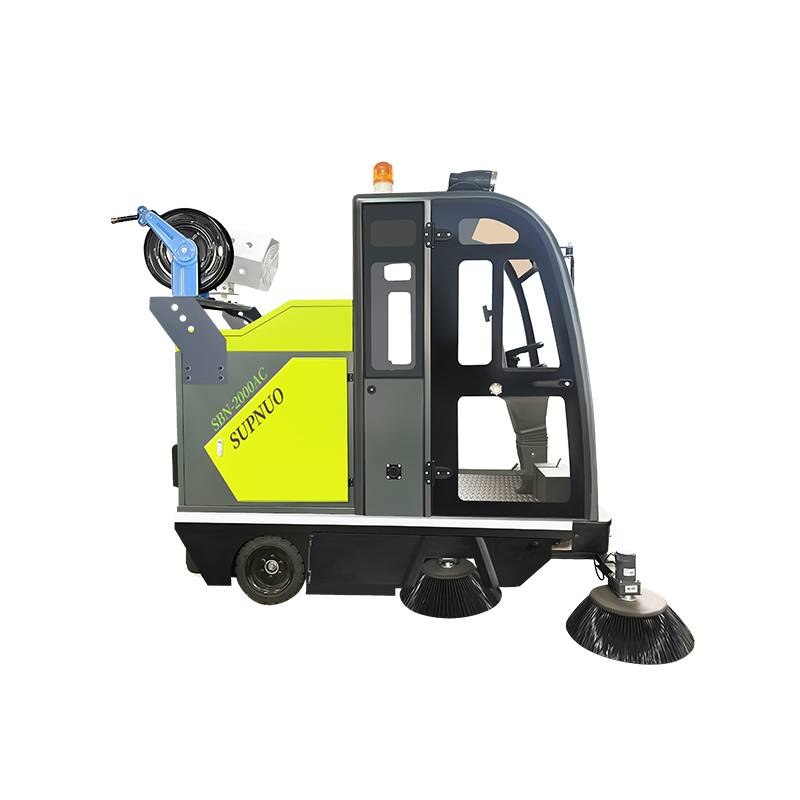
A ride-on sweeper is usually the right move when you have big, repeatable routes. OEMs and industrial cleaning suppliers commonly position rider sweepers for large-area productivity, while walk-behind units win on maneuverability.
If you want a quick sanity check, look at how major manufacturers categorize their sweeper lines (walk-behind vs. rider) in their own product navigation, such as Tennant’s sweeper categories (updated 2026).
Mechanical vs. vacuum-assisted sweepers
Mechanical (direct-throw) sweepers use brooms/brushes to move debris into a hopper. They can be very effective for larger dry debris.
Vacuum-assisted sweepers add suction and filtration. If airborne dust is a problem, this isn’t a “nice-to-have.” It’s the feature that protects your people, your product, and your floor finish.
Manual push vs. battery powered sweepers
Manual push sweepers can still make sense for small areas and light debris. But once sweeping becomes a daily program, battery power usually wins because it reduces fatigue and keeps results consistent.
Nilfisk’s overview of industrial manual sweepers (updated 2026) is a good reference point for what manual sweepers can and can’t do.
Step 3: The evaluation criteria that decide the purchase (and the headaches)
This is where you avoid the common trap: choosing by a single spec.
1) Dust control and filtration (often the real deal-breaker)
If you sweep fine dust indoors, your “sweeping problem” is often an air-quality and housekeeping problem.
In the U.S., OSHA’s silica guidance includes a plain-language housekeeping constraint: employers must not allow dry sweeping or dry brushing where it could contribute to respirable crystalline silica exposure unless wet sweeping, HEPA-filtered vacuuming, or another method that minimizes exposure is not feasible. See OSHA’s silica housekeeping note (updated 2026).
That doesn’t mean every warehouse needs a HEPA sweeper. But it does mean you should evaluate dust control like an EHS decision, not a cleaning preference.
Practical questions to ask vendors:
Is the machine vacuum-assisted, and how does it prevent re-aerosolizing dust during operation and dumping?
What filtration is used, and how is filter performance maintained over time?
Can maintenance tasks (filter cleaning/replacement) be done without making a dust cloud?
OSHA defines HEPA as 99.97% efficient at 0.3 micrometers and addresses HEPA-filtered vacuuming in general-industry silica guidance. See OSHA’s Silica General Industry FAQs (PDF) (updated 2025).
⚠️ Warning: Don’t treat “HEPA” as a checkbox. If filters are hard to service, teams skip maintenance, and dust control degrades fast.
2) Route fit: aisle width, turning, and operator visibility
You don’t need a perfect CAD model to get this right. You need one real test:
Can the machine run your route without constant three-point turns, scraping racking, or forcing operators to “make it work”?
During a demo, drive the sweeper through:
your narrowest aisle
your tightest corner
your busiest cross-traffic point
If it’s stressful in the demo, it will be worse at 2 a.m. on a rushed shift.
3) Sweeping path and productivity (what you can actually cover)
Sweeping width and “square feet per hour” claims can be useful.
But treat them as a starting point, not the truth.
Productivity is a system outcome: route complexity, dumping frequency, dust performance, and whether the unit can run your full cleaning window.
A decent overview of common sweeper categories and selection considerations is in Imperial Dade’s “Industrial Floor Sweepers 101” (updated 2025).
4) Hopper capacity and dumping workflow
Hopper size matters less than how often your crew has to stop.
Ask:
How often will this hopper need to be emptied on your dirtiest day?
How clean is the dump process? (Dust escape is an EHS and housekeeping issue.)
Can one operator dump it without a second person?
A “big hopper” that is miserable to dump becomes a work-around (and then a skipped step).
5) Battery runtime, charging, and shift coverage
For electric sweepers, the question isn’t “How long does it run?”
It’s “Can it cover our real cleaning window without creating a charging bottleneck?”
For multi-site operations, also ask:
Are we standardizing on one charging approach?
Do we need opportunity charging between routes?
What happens when the battery ages and runtime drops?
6) Maintenance access, wear parts, and service support
Facilities teams don’t have time for delicate machines.
Your best proxy for real-world uptime is how fast a mechanic can:
access filters
replace brooms/side brushes
clear a jam
get a part in hand
Also: insist on a support plan you can operationalize.
If a vendor can’t clearly explain parts availability and warranty/service workflow, that’s not a small issue. It’s a forecast of downtime.
Step 4: Build your must-haves and your deal-breakers
Keep this simple. Your goal is to make procurement easier, not harder.
Common must-haves for manufacturing sites
Fits your tightest aisle/doorway with margin
Dust control that matches your risk profile (especially indoors)
Easy-to-service wear parts (brushes, filters)
A dumping process your team will actually use consistently
Support plan: parts, warranty terms, and service response you can trust
Common deal-breakers (red flags)
The demo route is avoided or “cherry picked”
Maintenance is described as optional or “maintenance-free”
Dust control is vague (“it’s good”) rather than explained
Warranty and parts support are unclear
Step 5: How to run a sweeper demo (a checklist you can reuse)
Bring the stakeholders who will feel the consequences: the operator, maintenance, and EHS.
Route test: run the tightest aisle + tightest turn.
Dust test: sweep your dustiest zone and watch for visible airborne dust.
Pickup test: sweep your most common debris, then your worst-case debris.
Dump test: empty the hopper once. Evaluate mess, ergonomics, and time.
Service test: open the machine and inspect filter/brush access.
Support test: ask the vendor to explain parts lead time and service process in plain language.
If you want a broader framework for structuring demos and vendor evaluation, SUNBON has a practical internal checklist approach in its floor cleaning machine buyer’s guide.
Step 6: A simple TCO checklist (without fake precision)
You don’t need a complicated calculator to start.
Use these inputs to compare options consistently:
Purchase price and warranty terms
Expected wear parts: main broom, side brooms, filters (frequency + cost)
Labor hours per week to meet your floor standard
Downtime risk: service response time, parts availability, and ease of repair
Charging infrastructure and battery replacement assumptions
The point isn’t to predict the exact number. It’s to avoid a decision based on price tag only.
Where one vendor example fits (based on verifiable specs)
If you’re evaluating rider sweepers for larger routes, one reference point is the SBN-25000AW ride-on sweeper. The product page lists a 2500 mm sweeping width, cleaning efficiency over 15,000 m²/h, and positions the unit as combining suction, sweeping, and spraying for dust control.
Treat those as starting specs, then validate route fit, dust performance in your space, and serviceability in a real demo.
Next steps
If you want, share three details and you can get to a clean shortlist fast:
your approximate square footage and aisle width constraints
your top debris types (especially fine dust)
your cleaning window (minutes per shift)
Then align your shortlist to the criteria above, run a real route demo, and document the service plan like you would for any other critical piece of plant equipment.
Pro Tip: If you manage multiple sites, standardize the demo checklist and PM routine first. Model selection becomes easier when evaluation is consistent.





