
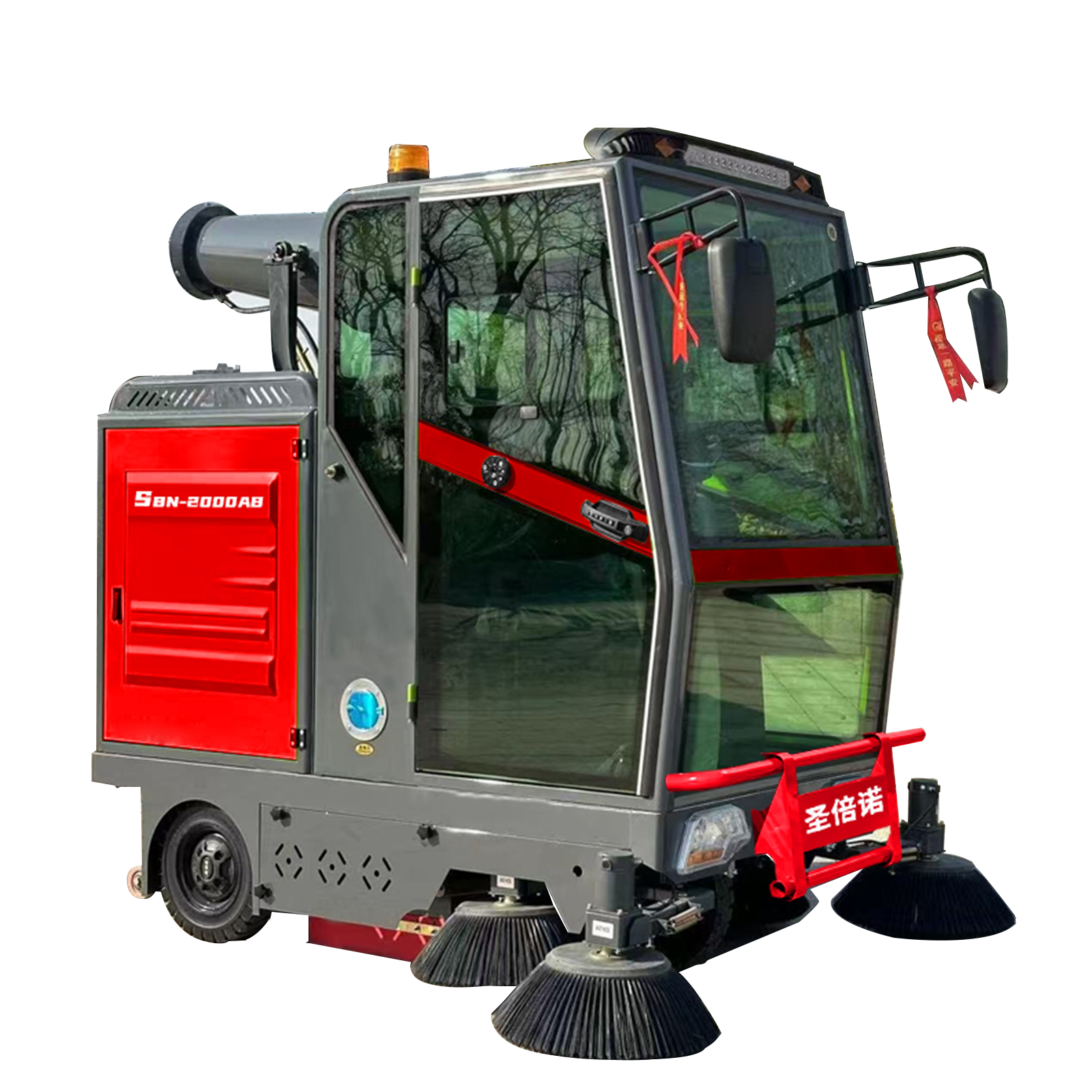

If you’re seeing dust trails along forklift lanes, debris building up under racking, or slip hazards near dock doors, you don’t need a “bigger cleaning team.” You need a faster, more consistent way to keep floors under control.
A small ride-on sweeper is often the sweet spot for factories: it’s more productive than walk-behind sweeping, but still compact enough to navigate real-world aisles. In other words, it’s an industrial ride-on sweeper built for the realities of a busy factory floor sweeper route.
This guide walks through the specs that actually matter—battery type, cleaning width, hopper capacity, dust control, runtime, aisle width, indoor/outdoor use, and noise—so you can shortlist machines confidently and ask vendors the right questions.
Start with a quick needs assessment (it saves you from buying the wrong machine)
Before you look at spec sheets, answer three operational questions:
- What kind of debris are you dealing with most days?
- Fine dust (powders, cardboard dust, track-in)
- Mixed debris (small scraps, packaging, pellets)
- Heavier debris (chips, gravel near docks, outdoor track-in)
- Where will the sweeper run?
- Tight rack aisles
- Open production areas
- Dock doors and outdoor staging
- When will you sweep?
- During production (people + traffic nearby)
- Off-shift (faster, but noise may matter more for neighbors)
Those three answers determine whether you should prioritize filtration and dust suppression, maneuverability, ruggedness, or quiet operation.
The 8 criteria that matter most for a factory small ride-on sweeper
1) Battery type: lead-acid vs lithium (and what to ask about charging)
Most small ride-on sweepers for indoor factories are battery-powered. Battery machines are popular indoors because they avoid emissions and can be quieter.
When comparing battery systems, ask:
- What battery chemistry is offered? (lead-acid vs lithium)
- What’s the real runtime under load? (not just ideal conditions)
- What’s the charge time, and do you offer opportunity charging?
- What’s the battery warranty and expected service life?
Practical tip: match battery strategy to your schedule.
- If you want to sweep during a single daily window, you need a battery that comfortably covers the route with time for dumping and detours.
- If you need multiple shorter sweeps across a day, you’ll care more about fast charging and practical charging logistics.
2) Cleaning width: the “productivity vs aisle fit” tradeoff
Cleaning width affects how quickly you can cover open space. But in factories, the biggest bottleneck is often geometry—the machine has to physically fit your route.
Choose the width based on:
- your tightest aisle sections
- doorways and pinch points
- the number of turns per route (more turns = maneuverability matters more)
If you’re routinely weaving around pallets, work-in-process, or staging areas, a slightly narrower machine that turns well can outperform a wider one that forces awkward multi-point turns.
Pro Tip: Walk the route with a tape measure and write down your smallest doorway width, narrowest aisle, and the tightest 90° turn. Bring those numbers to every vendor call.
3) Hopper capacity: how often you’ll stop (and how painful dumping will be)
The hopper is the “debris bin.” If it’s too small, you lose time stopping and dumping. If it’s large but hard to empty, it still slows you down.
Ask vendors:
- What’s the hopper capacity?
- How do you dump it? (manual, low-dump, or high-dump)
- Can you dump into your existing waste containers safely?
If your factory sees bulky debris (packaging scraps, pellets, track-in near docks), hopper size and dump method matter more than you’d think.
4) Dust control and filtration: the make-or-break spec for indoor factories
If you’re dealing with fine dust, a sweeper that “looks productive” can still leave you with the same problem—because it re-suspends dust into the air.
Look for robust filtration and dust-control design. Tennant, for example, highlights the value of multi-stage dust control systems when choosing ride-on sweepers.Tennant’s checklist of sweeper buying considerations
What to ask:
- What filtration system is included? (and what options exist)
- How does the machine control dust while sweeping?
- How are filters cleaned and maintained? (manual shaker, automatic, service intervals)
- What happens to performance as filters load up?
If your dust includes materials that raise compliance concerns (for example, silica in certain environments), housekeeping methods matter. OSHA’s respirable crystalline silica standard for general industry includes specific housekeeping constraints—such as limiting dry sweeping/brush cleaning when it could increase exposures and favoring methods like wet sweeping or HEPA-filtered vacuuming where feasible.OSHA’s respirable crystalline silica standard (29 CFR 1910.1053)
(That’s not legal advice—but it is a practical reminder: don’t treat dust as “just cosmetic.”)
5) Runtime: plan for your real cleaning window
Runtime isn’t only about battery size. It’s also about how you operate:
- how fast you drive
- how dense debris is
- how often you stop to dump
- how frequently you sweep (one long route vs multiple short passes)
Ask for runtime expectations based on a route similar to yours, and confirm whether performance drops significantly as the hopper fills or filters load.
6) Aisle width and turning radius: measure first, buy second
For factories, this is often the #1 reason a “great” sweeper fails.
Even if a machine fits your aisle on paper, you still need to turn at aisle ends, navigate around columns, and handle staging creep.
Use a simple checklist:
- Narrowest aisle (between racks/pallets)
- Tightest 90° turn
- Doorway widths and thresholds
- Any ramps, dock plates, or uneven transitions
If your tightest areas are truly constrained, a walk-behind sweeper may still be the better tool for those zones—even if you use a ride-on for the main aisles.
7) Indoor vs outdoor use: don’t assume “industrial” means “all terrains”
A machine that’s great for smooth indoor concrete isn’t automatically a good fit for outdoor yards or rough dock approach areas.
If you plan to sweep both:
- Confirm the machine is rated for indoor/outdoor
- Ask about tire type and traction
- Ask how the dust-control system performs outdoors (wind + larger debris changes the game)
If outdoor sweeping is frequent, you may need a more rugged configuration—or a separate tool for outdoor areas.
8) Noise limits: look at dBA and exposure, not just “quiet” claims
Noise matters in two ways:
- Worker exposure (hearing conservation)
- Operational disruption (cleaning during production, night shifts, neighbors)
OSHA notes that workplace noise exposure around 85 dBA (8-hour TWA) triggers a hearing conservation program, and recommends measuring noise exposure and applying controls where needed.OSHA guidance on occupational noise exposure
What to do with this as a buyer:
- Ask vendors for the machine’s sound level (dBA) under typical operating conditions.
- If noise is a concern, measure on-site exposure when testing equipment—especially if sweeping happens for long stretches.
Red flags that usually mean “keep shopping”
A few warning signs that show up in real factory deployments:
- The vendor can’t clearly explain the dust control/filtration system.
- The machine “fits” only if your aisles are perfectly clear (they never are).
- Runtime claims don’t include any assumptions.
- Maintenance basics are unclear: filter access, brush replacement, daily checks.
⚠️ Warning: If fine dust is your main problem, a sweeper that simply pushes dust around can make your facility feel worse—not better.
How to shortlist a small ride-on factory sweeper in 30 minutes
Here’s a fast process that works:
- Write down your constraints: narrowest aisle, tightest turn, indoor/outdoor, noise sensitivity.
- Pick 2–3 “must win” criteria: usually maneuverability + dust control + runtime.
- Ask vendors the same 8 questions (the criteria above).
- Request a test on your actual route, including an aisle-end turn and a dock-door transition.
Where Global Cleaning Equipment fits (if you want a starting point)
If you’re building your shortlist and want concrete examples, you can browse ride-on sweeper options from Global Cleaning Equipment and compare configurations:
- Browse models in the Global Cleaning Equipment shop
- Example industrial sweeper pages to compare:
- SBN-2000AC (factories + outdoor areas)
- SBN-2000B (industrial use cases)
- SBN-2450CX (scale-up reference)
FAQ: small ride-on sweepers for factories
Is a small ride-on sweeper worth it compared to a walk-behind?
If you have long aisles or large open floor areas, ride-on sweepers can reduce cleaning time and improve consistency. If your facility is tight and cluttered, walk-behind can still be the better choice for certain zones.
What’s the most important spec for dust-heavy factories?
Typically dust control/filtration, because it determines whether the machine actually reduces airborne dust or just moves it around.
How do I know if the machine is too loud for my site?
Ask for the rated dBA and verify with a real test. If operators are using the machine for long blocks of time, noise exposure becomes a management item—OSHA’s noise guidance explains why measuring exposure matters.
Do I need indoor/outdoor capability?
Only if you genuinely sweep outdoors often. Mixed indoor/outdoor use changes your needs around debris type, traction, and dust behavior.
If you share your narrowest aisle width, whether you sweep mostly fine dust vs mixed debris, and your preferred cleaning window (minutes per shift), we can recommend a short spec range to request from vendors—and help you eliminate mismatched machines early. You can also start by browsing options in the Global Cleaning Equipment shop.





