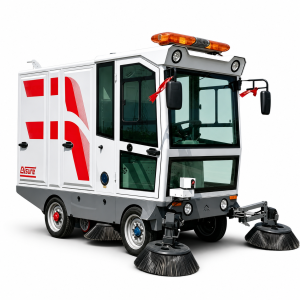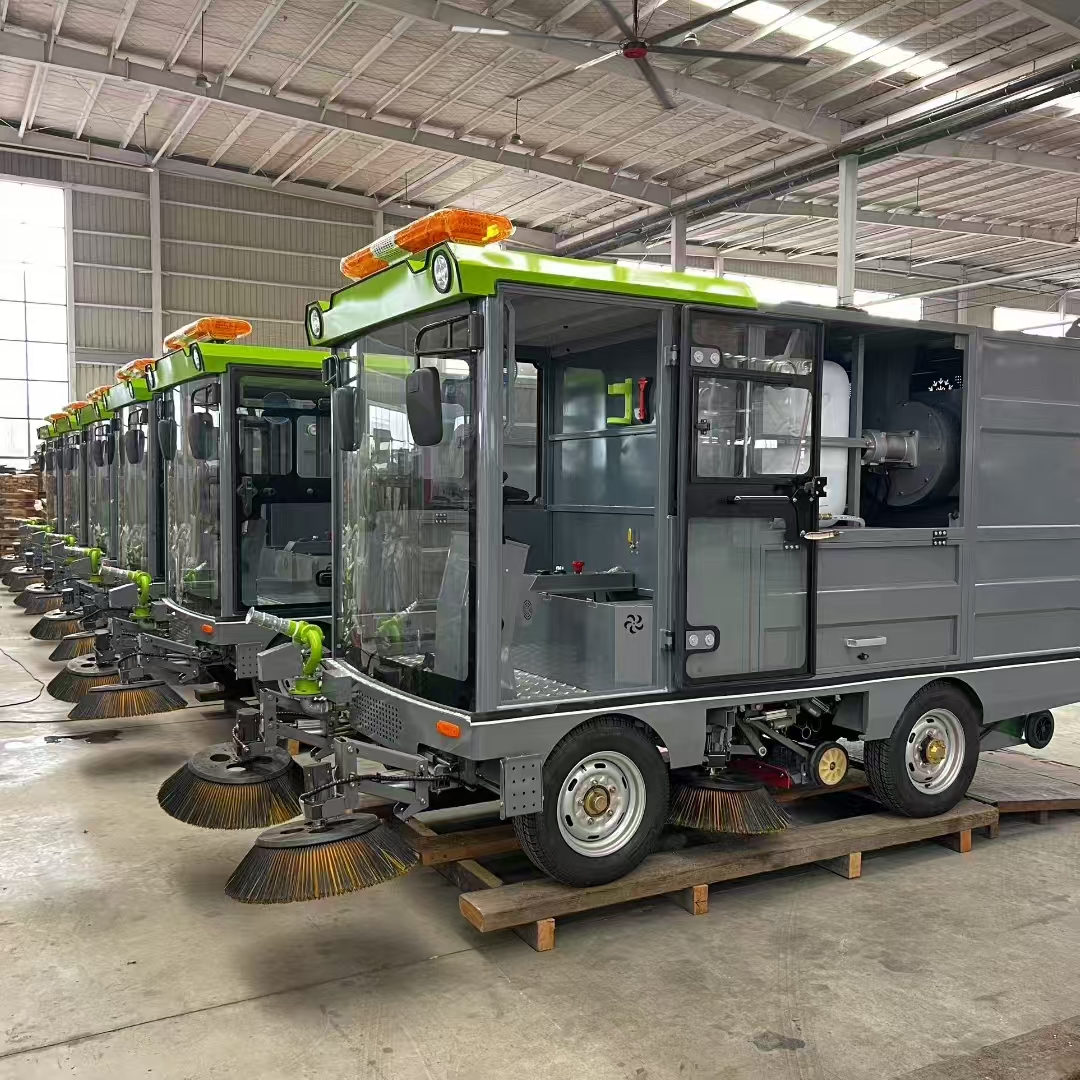
You already know you need a ride on sweeper. What you need is a defensible way to pick one, and a paper trail that survives your own procurement review. This ride on sweeper buying guide gives you that: a scoring framework you can drop straight into an RFP, built from the criteria that actually separate machines on municipal routes rather than the ones that fill a spec sheet.
Every figure in the sections that follow is either traced to a named source or labeled as an assumption you should verify against your own fleet data. Where the public record is thin, the guide says so instead of filling the gap with a number. Use it to size the machine to your debris load, score competing bids on the same scale, and model the ten-year cost before you commit.
Global Cleaning Equipment, associated with the Sunbon brand, manufactures industrial and commercial cleaning machines and has over 13 years of experience, with more than 300,000 machines delivered worldwide from four production bases. Its ride-on scrubbers and road sweepers are made by an in-house team of over 20 engineers, and its products are certified to CE and ISO9001. Because the company builds sweepers for municipal sanitation departments and similar buyers, this guide draws on its manufacturing and product knowledge of the category.
What a Ride On Sweeper Actually Has to Do on Your Routes
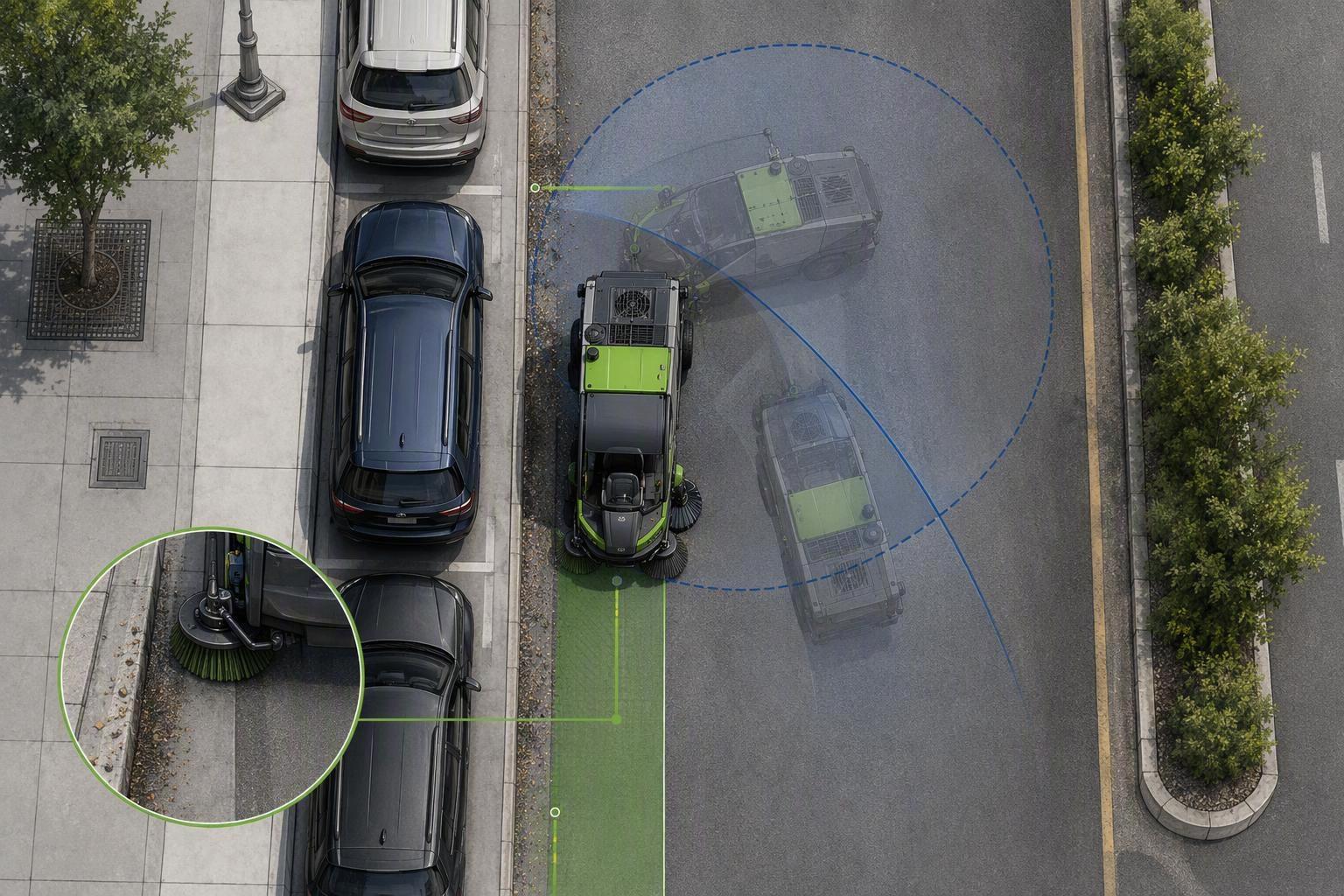
A ride on sweeper is a self-propelled machine with a cab, a debris hopper, and a pick-up system that travels the route at traffic speed. That is the dividing line from a walk-behind unit, which cleans a sidewalk while the ride-on machine works the curb line, gutter, and travel lane across miles of roadway in one shift.
Three pick-up technologies do that work, and they fail in different places. Mechanical broom sweepers rotate a cylindrical broom that flicks debris onto a conveyor into the hopper: strong on heavy coarse material such as sand and gravel, weaker on fines, and abrasive enough to break larger particles into smaller, more washoff-prone pieces. Vacuum sweepers pull debris under a suction nozzle and beat mechanical broom on fine material, but the nozzle typically spans only about one-third of the sweeping path width. Regenerative air sweepers push air through a blast orifice across a pick-up head covering the entire path width. All three descriptions come from Tymco’s own technology comparison, an OEM technical page read in 2026; it is vendor-authored, so treat the comparison as directional and confirm specifics against bid documents.
Technology | Best debris | Fine / PM10 performance | Pick-up head width | Key weakness |
|---|---|---|---|---|
Mechanical broom | Heavy coarse material: sand, gravel | Less effective on fines; broom action breaks particles down | Full path via broom and conveyor | Weak at cracks and potholes |
Vacuum | Mixed debris, better on fines than mechanical broom | Stronger on fine material | Nozzle ≈ 1/3 of sweep path | Windrow-broom weakness at cracks and potholes; exhaust can emit dust |
Regenerative air | Mixed debris across full path | Full-width pick-up head | Covers entire sweep path width | Depends on air containment at the head |
Table compiled from OEM technical descriptions; the only quantified cell (vacuum nozzle ≈ 1/3 of sweep path) is manufacturer-sourced and should be confirmed against bid specifications.
Fines decide the specification. FHWA’s guidance on respirable particulate describes modern sweepers as extremely effective at removing respirable PM10, and California transportation guidance reported that sweeping was cost-effective for reducing PM10 after winter sanding in the Lake Tahoe Basin. If your routes carry winter sanding residue or fine road dust, that is the requirement you are buying against.
What this machine class is not for: narrow sidewalks, tight downtown streetscapes with continuous parked cars, and pedestrian-only zones. A ride on street sweeper needs turning envelope and dump access, and forcing one into an 8-ft alley or a cul-de-sac turnaround costs more in damaged equipment and lost time than a smaller unit would.
Needs Assessment: Sizing the Machine to Your Actual Debris Load
Start with the unit of work, not the machine. A curb mile is one mile of sweeper path along a single curb or pavement edge, so a one-mile divided highway with two outside curbs and a raised median is four curb miles, not one. World Sweeper’s guidance on writing clear street sweeping RFPs notes that when “sweeping miles,” “curb miles” and “centerline miles” are used interchangeably, a nominal 100-mile contract can turn into 400 miles of actual curb. Define the curb mile before you release the RFP, and require the bidder to price against it.
Frequency is the second input, and it is local. There is no national sweeping schedule: the cadence comes from your own MS4 permit. EPA’s own MS4 program counts roughly 855 Phase I and 6,695 Phase II permittees, each operating under terms written for its watershed, which is why two neighboring towns can carry very different obligations.
Then map the shape of the load across the year. Winter sanding residue, leaf fall, and construction-tracked sediment each arrive in different months and different volumes, and a municipal street sweeper sized for the average month will be undersized in the peak one. Note your transfer-station dump height and your tightest turnaround before you compare any ride on sweeper, because those two constraints eliminate more candidates than debris volume does.
Evaluation Criteria: How to Score a Ride On Sweeper

A ride on sweeper is scored against your routes, not against a spec sheet. The eight criteria below are the ones that decide whether a machine fits a municipal street sweeper program, and each one carries a definition, a “what good looks like” line, and a way to verify the claim before you sign.
Criterion | What good looks like | How to verify it |
|---|---|---|
Sweep width and pick-up head coverage | Matches your widest and narrowest sweepable surface | Request a demonstration on your own route |
Hopper capacity vs. route length | Enough volume to finish the route without a mid-route dump | Compare capacity against measured debris load |
Dump height vs. receiving facility | Clears your tip floor and transfer station walls | Measure the facility, not the brochure |
Turning radius | Handles cul-de-sacs and alleys without a multi-point turn | Test the tightest turn on your network |
Power source vs. duty cycle and emissions obligations | Meets your air-quality or contract requirements | Ask for the emissions certification |
Water and dust suppression | Controls PM10 on your routes | Confirm tank size and spray coverage |
Parts and service continuity | Documented lead times and a named local service point | Ask for written lead times |
Operator and public safety provisions | Visibility, lighting, and warning systems for mixed traffic | Review the safety package |
Sweep width and pick-up head coverage, and fine-particle performance, are covered in the section 1 comparison table; use it rather than re-deriving those figures.
Cost consequences attach to several of these criteria. Across 60 municipal sweeper contracts across 36 governments, the median contract ran $390K, with the middle half between $264K and $708K (docketcity price dataset, retrieved 2025-09-17). Treat that as acquisition context, not a per-unit price.
No clean published per-unit price range exists for ride-on sweepers, and the circulating $200K–$350K figure carries no named methodology. Do not use it in your scoring sheet. Model total cost of ownership street sweeper figures from your own route data instead.
Red Flags and Deal-Breakers: When to Walk Away
Some gaps in a bid are worth negotiating. Others should end the conversation, because no amount of price movement fixes them later.
No documented parts lead times. Ask for published lead times on wear items: main broom, side brooms, squeegee, hydraulic filters. A vendor who cannot put those numbers in writing is telling you the after-sales network is informal. That becomes your problem in year three.
No enforceable performance guarantee tied to the specification. A guarantee that promises “clean streets” is not a guarantee. It has to reference the curb miles in your scope and the pass frequency you specified, or it cannot be measured or enforced.
No handover or operator-training scope. Training hours, materials, and a documented handover checklist belong in the contract, not in a verbal promise during the demo.
An RFP that leaves “mile” undefined. This is the most expensive red flag. A 100-mile RFP can become 400 curb miles once medians, islands, and divided highways are counted, and the bid you accepted was priced on the smaller number. To avoid it, define the curb mile before you release the RFP and attach the segment table and maps as contract documents, so payment follows defined curb miles rather than a later reinterpretation.
Key Takeaway:The curb-mile trap. One mile of divided highway with two outside curbs and a raised median is four curb miles, not one. Price the four.
A bid that prices centerline miles. If the unit price is per centerline mile, the vendor has either misunderstood the scope or is counting on the ambiguity. Either way, the number is not comparable to the other bids.
A vendor who will not state the machine’s limits. Every ride on sweeper has routes it should not be sent on. A supplier who claims universal fit has not read your route map, and you will discover the limits yourself after delivery.
Procurement Mechanics: Cooperative Purchasing, Schedules and the RFP
Most US municipalities do not run a standalone solicitation for a municipal street sweeper. They buy off an existing cooperative or state contract, and that choice is the single biggest lever on how long procurement takes.
Cooperative purchasing vehicles let you ride an award another public agency already competed. State and multi-state schedules work the same way: the pricing and terms were negotiated by a lead agency, and your role shrinks to confirming the awarded unit meets your specification and issuing a purchase order. A standalone RFP makes sense when your requirements fall outside any available award, when you need a configuration no schedule carries, or when local ordinance requires open competition above a threshold.
Either path still requires a written specification, and the specification is where bids become comparable or stop being comparable at all. Tie it to the obligation you are already under: EPA’s own MS4 program counts 855 Phase I MS4s and 6,695 Phase II MS4s as unit permittees, with watershed permits covering 3 Phase I and 40 Phase II communities. Those two counts are separate populations, not a split of one total, and a Phase II permittee faces a lighter but real street-sweeping expectation. Write the spec so every bidder answers the same measurable question, and use the red-flag list in the previous section as your pre-award screen.
Total Cost of Ownership: Modeling the Ten-Year Number
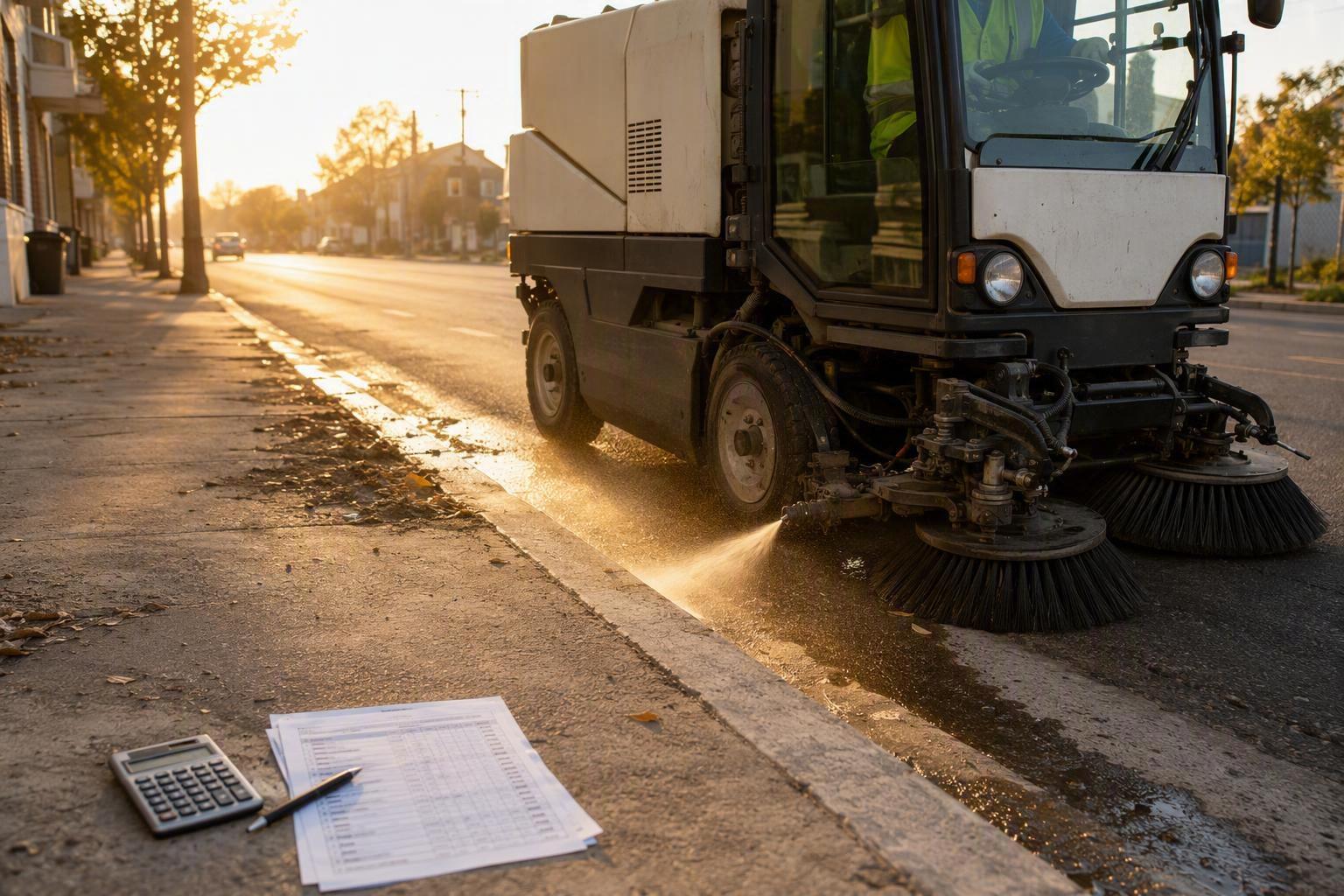
The total cost of ownership street sweeper calculation is where most municipal evaluations go wrong, because the purchase price is the smallest number in the model. Build the cost model from all eleven components rather than from the invoice: acquisition, financing, fuel or charging energy, brushes and wear parts, filters, water, preventive maintenance labor, unscheduled downtime, operator training, insurance, and storage.
The acquisition line is the one number you can benchmark against peers. The contract-value range in the scoring section above came from 60 contracts across 36 governments in 15 states, and it is wide enough that a single median tells you very little about your own route. No clean published price range for municipal sweepers was found during this research, so treat any vendor-supplied figure as unverified until you can trace it.
Every remaining line is an assumption you own. Label it as one in the worksheet, state the basis (your last three years of shop tickets, your fuel logs, your route hours), and let the cumulative column do the arguing.
A note on the evidence: the price, TCO and technology sections of this guide each rest on one defensible source. Where the record is thin, this article hedges rather than asserts, and you should apply the same standard to vendor claims.
What Success Looks Like After the First Year
A ride on sweeper is working if the numbers you specified are the numbers you are recording. Build the checkpoints into the first-year schedule so the evaluation happens on evidence rather than impressions.
Curb miles per shift. Compare actual swept curb miles against the route plan the machine was specified for. A shortfall usually traces to dump cycles, water refills, or turnarounds, not to sweeping speed.
Hopper loads per route. Load count is the cheapest proxy for debris capture. If loads drop while curb miles hold steady, the route is cleaner or the pickup is less effective, and only the operator can tell you which.
Consumables against the vendor’s stated intervals. Log brush and filter replacement dates. Vendors state intervals under assumed conditions; your intervals tell you whether those assumptions match your debris.
Dump-cycle time at the transfer station. Time spent queued is time not sweeping. Measure it once a quarter.
Permit recordkeeping. Sweeping is credited in MS4/TMDL accounting by the two crediting methods MS4 programs use: lane-mile or curb-mile multiplied by frequency, with higher credit for vacuum-assisted and regenerative air machines, and mass-based crediting that converts collected wet mass to dry mass and then to total nitrogen, total phosphorus, or total suspended solids using fixed factors. Some programs credit only the increment above a baseline year. The Maryland guidance that describes both methods was finalized on 5 November 2021. Tonnage figures from Maryland, Virginia and Bristol could not be re-verified for this guide, so no municipal totals are quoted here; confirm your own program’s factors directly with your state regulator.
A manufacturer-capability example helps here: a factory-direct OEM such as Global Cleaning Equipment supports buyers by documenting how a stated municipal street sweeper specification can be met, which is the form of proof worth asking for at handover. What you want in writing is the training scope, the parts lead times, and the warranty terms, because those three determine whether year one runs on your schedule or the vendor’s.
Frequently Asked Questions
How many curb miles can one ride on sweeper cover per shift?
No single figure holds across routes, because your route fixes the variables: travel speed between stops, dump and refill frequency, debris density, parked cars, and whether the operator sweeps one side or both. Ask any supplier for the assumptions behind its per-shift number, then test those assumptions on your worst route rather than your cleanest one. A supplier who will not state assumptions is quoting marketing, not a planning input.
Is a battery ride on sweeper viable for a winter sanding route?
Only if the machine is specified for it, which is a separate question from sweeping. Cold reduces usable battery capacity, and sanding adds a spreader plus a heavier payload cycle. Ask whether the unit is rated for winter service, what the manufacturer’s cold-weather operating envelope is, and how the dealer supports it in your climate. If the answers stay vague, plan on diesel for winter work and keep the battery machine for the sweeping season.
What happens if my MS4 permit allows an equivalent BMP instead of sweeping?
You still document whatever you do. An equivalent best management practice substitutes for the sweeping requirement; it does not exempt you from recordkeeping. Confirm the substitution in writing with your permitting authority before building a procurement around it, and check whether the alternative carries its own monitoring or reporting obligations. Permit language decides what counts, not the equipment brochure.
How do I compare bids that price different units of work?
Normalize every bid to one unit before comparing totals. The common units are per curb mile swept, per hour of machine time, and per ton of material removed. Convert each proposal to the unit your own records use. This is also where the total cost of ownership street sweeper model earns its place: a lower hourly rate can lose to a higher one once consumables, downtime, and parts lead times are counted.
Does a ride on sweeper replace a walk-behind on downtown sidewalks?
Usually not. Ride-on machines are the wrong tool for narrow sidewalks, tight storefront clearances, and pedestrian-heavy blocks. Most municipalities run both: ride-on units for streets and wide paths, walk-behind or smaller units for the sidewalk network. Set the split by measuring your actual sidewalk widths and clearances instead of assuming one machine covers the whole route.
Conclusion
The framework you now have is deliberately unglamorous, and that is the point. Assess your actual debris load and route geometry before you look at a single machine. Score candidates against weighted criteria you wrote down yourself, not against the features a salesperson chose to lead with. Treat the red flags as disqualifiers rather than negotiation points, because a missing parts lead time or an unenforceable performance guarantee does not improve after the contract is signed. Then model total cost of ownership across a full ten years, including the consumables, downtime and training that never appear on the quote sheet.
A ride on sweeper is a ten-year commitment for most municipal fleets, so the work you do before the RFP is the work that determines whether the machine still fits your routes in year seven. This ride on sweeper buying guide exists to make that evaluation repeatable, and to give you a scoring sheet you can hand to a colleague or attach to a procurement file.
When you are ready to move from framework to specification, request the specification sheet or talk to our team about a route assessment for your streets.